






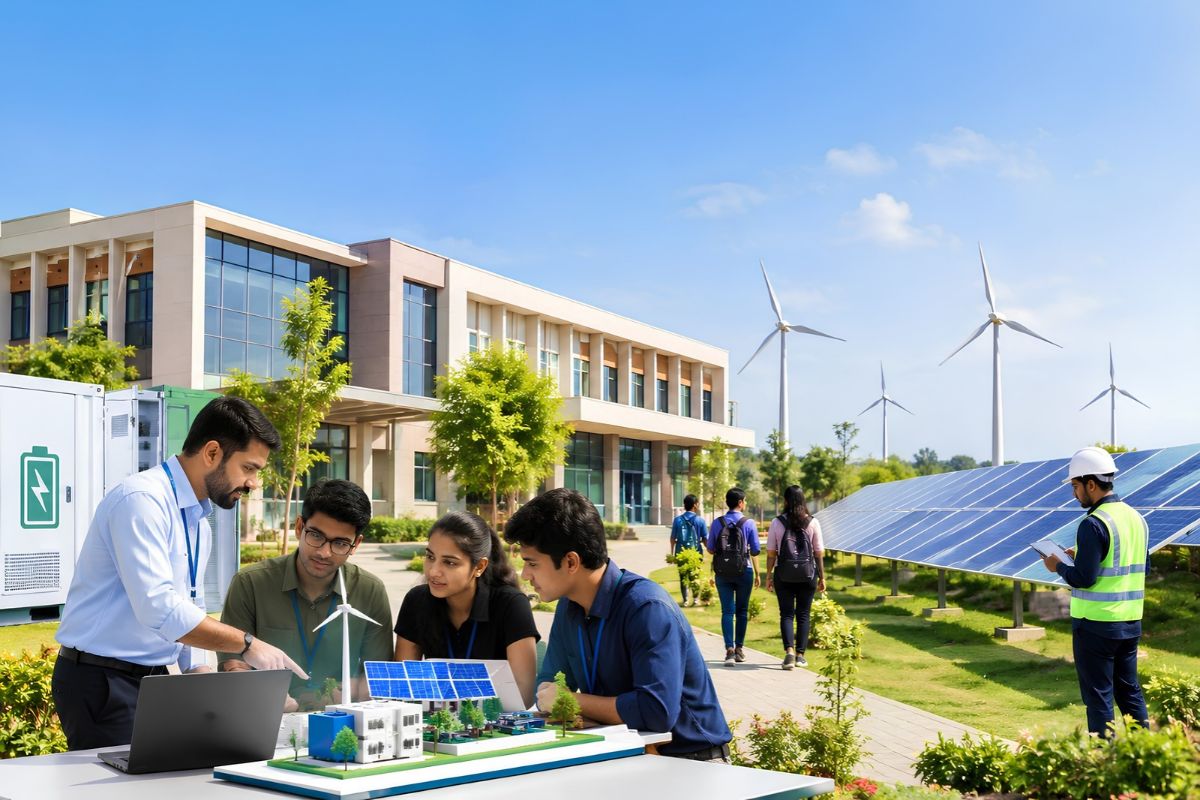
To host the Adani Group’s new facility, Krantiguru Shyamji Krishna Verma Kachchh University is dedicating public infrastructure. The Adani-Kachchh University Centre of Excellence funding structure remains partially undisclosed pending Right to Information (RTI) requests, but the operational setup reveals the state university is supplying real estate and administrative staff to subsidize a corporate training pipeline.
Who pays for the Adani-Kachchh University Centre of Excellence?
The partnership agreement outlines a funding model heavily reliant on taxpayer resources. According to the university’s operational framework, Kachchh University assumes responsibility for the physical infrastructure and campus integration. Adani Skills & Education contributes the curriculum and specialized training modules, as detailed in their official corporate announcement [1]. This arrangement leaves the public ledger covering recurring infrastructural costs. The university provides the foundation, and the corporation supplies the branding and the syllabus.
Is the initiative corporate philanthropy or public subsidy?
The structural reality of the cost-sharing setup functions as a public subsidy, contradicting the corporate narrative of a fully funded philanthropic initiative. When announced on October 4, corporate statements framed the facility as an investment in regional youth. According to the company’s press release, Karan Adani, Director of the Adani Group, stated that the project ensures “Talent Security” for India’s critical sectors [1]. By utilizing state university facilities for corporate training in Gujarat’s public university initiatives, the program leverages taxpayer assets to reduce corporate overhead.
Does the curriculum prepare students for employers other than Adani?
The academic framework limits graduates’ options in the broader industry because it uniquely serves the Adani Khavda renewable energy park training requirements. A review of the Centre’s stated focus areas shows a hyper-specific alignment with the microgrids, SCADA (Supervisory Control and Data Acquisition, a system of software and hardware elements used to control industrial processes), and IoT (Internet of Things, networks of connected sensors) systems required at Adani’s Khavda facility. When compared to standard All India Council for Technical Education (AICTE, the national statutory body for technical education) renewable energy degrees, the bespoke curriculum leans heavily into localized operational needs. Graduates trained exclusively on these custom modules face a disadvantage when applying to competing energy firms. Industry hiring standards prioritize broad foundational engineering over single-site operational training.
Are state-funded faculty being diverted to private training?
Staffing the Centre requires pulling existing resources from the university’s academic ecosystem. State-salaried professors and university staff oversee the campus facilities and student administration for these corporate-specific programs. With Kachchh University’s existing faculty roster managing the administrative and foundational teaching loads, the university’s payroll covers significant instructional overhead. By utilizing state employees to deliver and support its customized curriculum, Adani directly reduces its own corporate onboarding costs.
What is the public return on investment for Kachchh University?
Kachchh University administrators justify the resource allocation by projecting local employment gains. The administration maintains that the partnership brings technical training to a rural region, defending the state’s infrastructural investment. The state absorbs the training risk, but the public announcements lack a quantified, ironclad hiring mandate for the 10,000 students the facility expects to train annually [1]. The university produces a custom-trained workforce at public expense, but the corporation ultimately decides how many Adani green energy jobs in Kutch will actually materialize.
Frequently Asked Questions
Who is funding the Adani-Kachchh University Centre of Excellence? Kachchh University provides the real estate and administrative backbone, while Adani Skills & Education provides the curriculum and specialized training modules. This structure places the recurring infrastructural costs of the corporate training program on the public university’s ledger.
What will students learn at the new green energy centre? The Centre focuses on microgrids, SCADA systems, and IoT-based energy applications. However, the curriculum is hyper-specifically aligned with the proprietary systems required at Adani’s Khavda renewable energy park, rather than broad industry standards.
Are Adani green energy jobs in Kutch guaranteed for graduates? No, the public announcements and partnership framework lack an ironclad, quantified hiring mandate. While the facility expects to train 10,000 students annually, the Adani Group ultimately decides how many graduates will receive permanent job offers.