






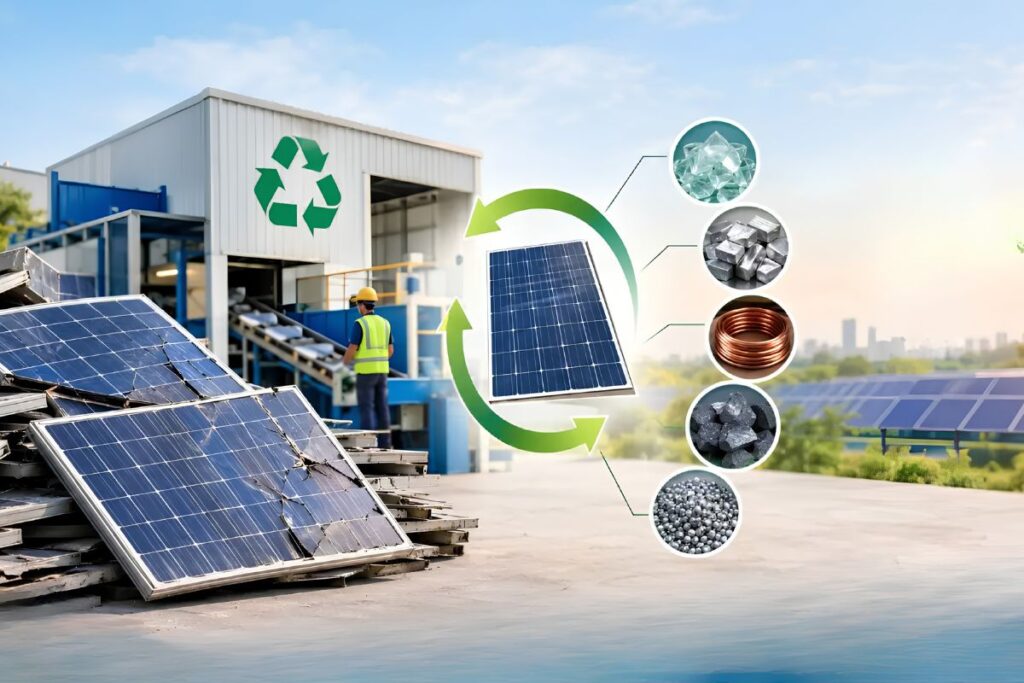
Recycling plants cannot chemically extract pure silicon and silver from India’s older solar panels because the polymers binding them are unstandardized and chemically degraded. Instead of dissolving smoothly, these mixed plastics resist industrial solvents and release corrosive acids during heat treatment, forcing recyclers to crush panels into low-value construction rubble.
Why Does Chemical Recycling Fail on India’s Early Solar Scrap?
Commercial recycling plants recover under 15% of intact silicon wafers from early-generation panels, despite lab trials demonstrating 95% recovery rates. Industrial scrap feedstocks fail to match the uniform conditions found in controlled academic trials.
Delamination is the industrial process of separating a panel’s protective front glass, semiconductor silicon wafer, and polymer backsheet by dissolving or burning away the encapsulant resin between them. Research documented by the CSIR-National Metallurgical Laboratory shows that while fresh test laminates delaminate uniformly, aged industrial composite panels develop micro-fractures and uneven heat transfer that shatter fragile crystalline silicon wafers during separation.
When these heterogeneous panels enter industrial solvent baths or high-heat furnaces, wafers snap under uneven thermal expansion. The resulting broken fragments cannot be reprocessed into high-purity solar wafers, collapsing recovery values.
How Do Degraded Polymers Block Chemical Solvents?
Decade-old encapsulant layers cannot be dissolved by standard chemical solvents because prolonged sun exposure creates dense cross-linked molecular networks.
Most silicon photovoltaic modules rely on ethylene-vinyl acetate (EVA), a rubber-like thermoset copolymer resin cured under heat to protect solar cells from moisture and physical shocks. In a brand-new panel, organic solvents like toluene or trichloroethylene swell the resin and dissolve the bond, freeing the clean silicon cell.
A decade in the heat of Rajasthan or Gujarat alters that chemistry. Chemical degradation research from the National Renewable Energy Laboratory demonstrates that intense ultraviolet radiation and high operating temperatures trigger severe polymer cross-linking and photo-thermal oxidation. The polymer chains bind tightly into an insoluble gel matrix that blocks solvent penetration.
Early import consignments also mixed different polymers. While some manufacturers used standard ethylene-vinyl acetate, others deployed early polyolefin elastomer variants, flexible thermoplastic synthetic resins, or proprietary curing chemicals to trim manufacturing expenses. Because industrial solvent baths require a single, predictable chemical reaction, feeding mixed batches of differing plastics stalls the line entirely.
Why Did the 2014–2020 Solar Boom Create an Unmapped Feedstock?
Between 2014 and 2020, Indian power developers imported millions of photovoltaic modules without uniform material standards to win competitive reverse-auction power bids.
During that six-year window, solar developers drove auction tariffs down from ₹6 per kilowatt-hour to under ₹2.50. Meeting those aggressive project numbers required developers to source 80% to 90% of their hardware from overseas factories, primarily in China and Southeast Asia.
Most of those shipments entered India before the Ministry of New and Renewable Energy enacted mandatory quality registrations under the Solar Photovoltaics Systems, Devices and Components Goods Order of 2017. Imports also predated the operational enforcement of the Approved List of Models and Manufacturers.
Dozens of the original equipment manufacturers that supplied those installations have since liquidated, merged, or modified their product lines. As a result, decommissioned panels arrive at Indian recycling yards without bills of materials, leaving operators with no documentation of the specific polymers sealed inside.
Why Does Thermal Delamination Create an Acid Hazard?
Thermal delamination releases corrosive hydrofluoric acid gas from fluoropolymer backing sheets, damaging industrial steel reactors and endangering worker health.
Pyrolysis, the thermal decomposition of materials at elevated temperatures in an oxygen-depleted atmosphere, serves as the primary mechanical alternative when chemical solvent baths fail to dissolve the encapsulant. On legacy modules, this heat treatment introduces an operational bottleneck.
Most modules installed during the 2014–2020 surge use protective backsheets fabricated with fluoropolymers such as polyvinyl fluoride or polyvinylidene fluoride. Industrial emission analyses compiled by the International Energy Agency Photovoltaic Power Systems Programme confirm that heating fluorinated backsheet polymers past 350 degrees Celsius breaks carbon-fluorine bonds, generating toxic hydrogen fluoride gas.
Hydrogen fluoride forms hydrofluoric acid upon contact with moisture, corroding standard industrial carbon steel. Handling these exhaust gases requires reactors built from expensive nickel-chromium superalloys and multi-stage alkaline chemical scrubbers. For commercial recycling operators, the capital expense of installing and maintaining specialized acid scrubbers exceeds the market value of the silver and silicon they extract.
What Happens to Legacy Panels When Chemical Extraction Fails?
Because chemical solvents fail and thermal processing generates acid risks, recyclers resort to mechanical downcycling, crushing panels into low-grade aggregate.
Downcycling is an industrial recycling pathway where composite materials are shredded into lower-grade mixtures that cannot be reused in the original high-value application. After pulling off the aluminum frame and copper junction box, processors feed the laminated glass and cell core into commercial hammer mills and industrial shredders.
The output is an unsorted aggregate containing roughly 70% to 75% crushed soda-lime glass mixed with pulverized backsheet plastics, silicon dust, and trace heavy metals. Economic assessments from the Council on Energy, Environment and Water show that mechanical shredding produces steep financial losses because plastic-contaminated glass cullet sells at a fraction of virgin silica prices.
While operators follow the [Central Pollution Control Board Guidelines for Storage and Handling of Waste Solar PV Modules](https://eprewaste.cpcb.gov.in/assets/PDF/Guidlines%20for%20Storage%20and%20Handling%20of%20Waste%20Solar%20Photo-Voltaic%20Modules%20or%20Panels%20or%20Cell%20(Under%20E-Waste%20(Management)Rules,%202022_0001_compressed.pdf) to contain dust and toxic lead runoff, the shredded glass cannot be remelted into solar-grade sheets. It ends up sold for nominal sums as road sub-base fill or cement kiln filler, losing silver and semiconductor-grade silicon into the slag.
Frequently Asked Questions
Why can’t recyclers recover pure silver and silicon from India’s older solar panels?
Recyclers cannot recover pure metals because the polymer encapsulants holding the panels together cross-link and degrade under desert heat, blocking chemical solvents from releasing the silicon cells. When heated in furnaces, the fluorinated backsheets emit corrosive hydrofluoric acid gas, making high-temperature separation commercially unviable.
What is the difference between solar panel recycling and downcycling?
True recycling separates panels into high-purity components, such as electronic-grade silicon wafers, silver paste, and clean glass, for reuse in manufacturing. Downcycling shreds the mixed panel into a contaminated aggregate sold cheaply as construction backfill or cement additives, permanently losing the valuable semiconductor materials.
How does hydrofluoric acid gas affect solar panel recycling plants?
When legacy panel backsheets containing fluoropolymers like PVF or PVDF are heated past 350 degrees Celsius, they break down into hydrogen fluoride gas. This gas forms hydrofluoric acid, which corrodes conventional industrial reactors and requires specialized nickel-alloy furnaces and wet scrubbers that cost more than the scrap metals recovered.