






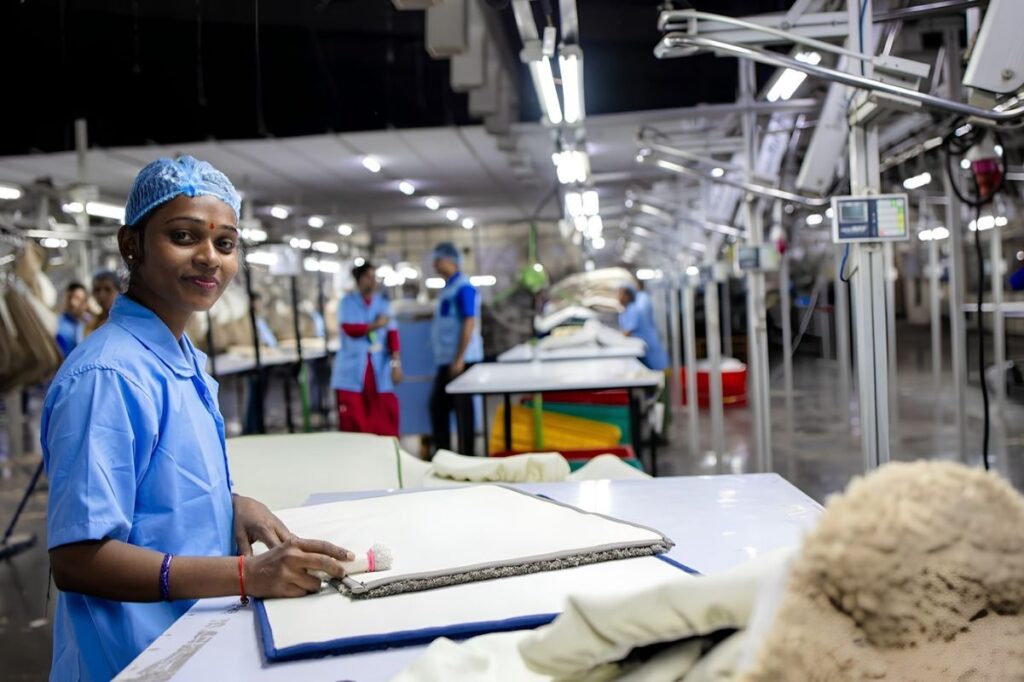
Indian non-tech companies are deliberately decoupling business growth from headcount growth. Instead of adding payroll to meet surging demand, corporations are redirecting their capital into enterprise software and Indian manufacturing automation. This makes the current India hiring stall a permanent structural shift in how businesses scale, rather than temporary economic caution
Why is Indian manufacturing automation replacing payrolls?
Financial data reveals that corporate capital is flowing heavily across the country, but it is bypassing human resources.
According to an economic analysis from The CapTable, India’s capital stock grew 74% over the last decade, while employment expanded by just 36%. Market tracking from MarketSmith India confirms that IT and AI-infrastructure capital expenditure (capex), funds used by a company to acquire or upgrade physical assets or technology, compounded steadily through the first quarter of the 2027 financial year.
This capital expenditure vs labor trajectory shows a clear mandate toward technological upgrades over mass hiring among India’s largest traditional companies.
Is there a gap between factory output and employment?
In October 2026, the S&P Global India Purchasing Managers’ Index (PMI) registered a four-month high for business output, yet the employment sub-index remained flat.
Mainstream reports attributed this divergence, often characterized as jobless growth in India, to corporate caution. The financial data contradicts this caution narrative. Companies are spending aggressively to capture demand; they are simply choosing to invest in systems rather than salaries.
According to the Annual Survey of Industries, the share of workers’ wages in organized manufacturing gross value added nearly halved even as output rose, confirming a structural shift.
Why are corporate boards mandating software over hiring?
The shift toward enterprise tech is a deliberate, top-down strategy directed by corporate boards.
A recent Thoughtworks Global CIO Survey found that Indian Chief Information Officers now hold unprecedented influence over corporate strategy, with 32% of respondents accelerating enterprise software investment and data automation. A parallel Gartner manufacturing report confirms IT executives are under direct pressure from leadership to absorb business growth and improve productivity through targeted software implementations.
Technology teams are now tasked with engineering operations so that output can scale rapidly without triggering a parallel rise in human operational expenses.
Which specific software systems are replacing human jobs?
The capital allocated for IT upgrades translates into specific systems designed to bypass human labor on the factory floor and in the back office.
Logistics and manufacturing sectors are aggressively purchasing autonomous mobile robots, AI-enabled demand forecasting, and smart warehouse management systems, according to industry tracking by Elite Group India.
These installations directly target the clerical, logistical, and forecasting roles that historically formed the bulk of mid-level corporate hiring during periods of high economic demand.
Is the Indian volume-hiring era permanently over?
Corporate leaders argue that adopting automation is the only way Indian manufacturing can control margins and remain globally competitive.
Economic analysts at The CapTable conclude that automation is permanently weakening the historical link between investment and job creation. Capital deployed into highly automated categories is now generating exponential output with minimal labor demand.
The data indicates that even if the broader economy runs hotter, the historical link between rising factory output and mass job creation is permanently severed.
Frequently Asked Questions
Why aren’t Indian manufacturing companies hiring despite high output? Instead of adding payroll to meet surging demand, Indian corporations are redirecting their capital into enterprise software and automation. This allows them to scale output without taking on long-term human operational expenses.
What specific automation systems are these companies buying? Manufacturing and logistics firms are purchasing autonomous mobile robots, AI-enabled demand forecasting tools, and smart warehouse management systems. These technologies directly replace mid-level clerical, logistical, and forecasting roles.
Will these manufacturing jobs come back when the economy improves? No. Economic analysts conclude that the historical link between capital investment and mass job creation is permanently severed, as capital deployed into automated systems generates exponential output with minimal labor demand.