






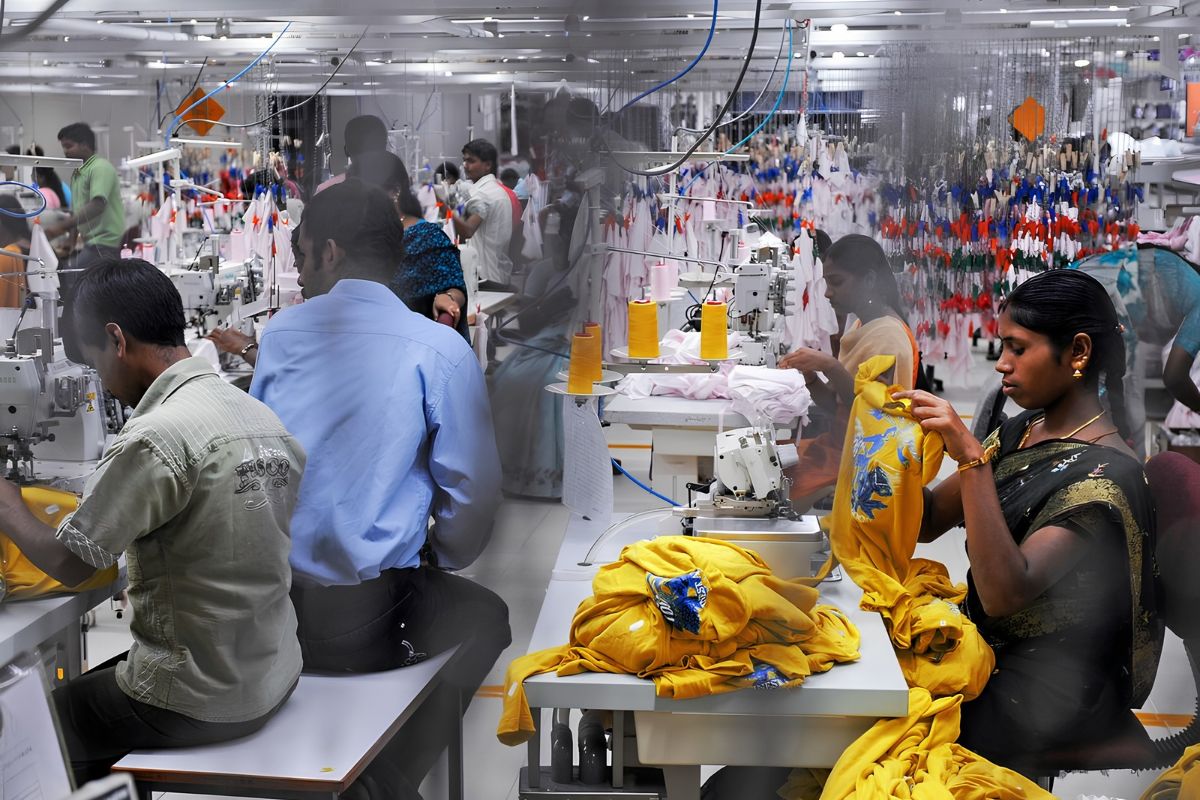
India’s national economy avoided global turbulence, but small manufacturing hubs absorbed the impact. While top-line national growth remains stable, India manufacturing job losses are accelerating. Local factories in export centers like Tiruppur and Surat are closing due to canceled foreign orders, forcing working-class manufacturing towns to pay the price.
Where Are India Manufacturing Job Losses Happening?
National growth metrics obscure localized economic contractions. In specific manufacturing clusters, the global economic slowdown translates directly into factory closures and payroll reductions.
In the diamond processing hub of Surat, factory closures and mass job losses hit the workforce so hard that over 60 factory workers took their own lives, according to The New Indian Express.
The financial damage spans multiple labor-intensive sectors. According to Apparel Resources, Surat’s weaving industry voluntarily cut production because weak cash flow and soaring raw material costs completely erased the margins for small operators.
Why Does National Economic Data Hide Local Job Losses?
Finance Minister Nirmala Sitharaman recently stated that India weathered global economic turbulence with its fundamentals intact. The national data supports this baseline: headline GDP growth remains high.
The government accurately reports this aggregate stability, which successfully prevents a wider systemic financial crisis. Yet Ministry of Commerce data reveals distinct sector contractions occurring beneath that national umbrella.
According to The New Indian Express, garment exports from Tiruppur declined to ₹42,544 crore in the 2025-26 financial year, dropping from ₹44,747 crore the previous year. This drop in Tiruppur garment exports was driven heavily by United States tariffs and reduced European demand.
How Are MSMEs Bearing the Cost of the Global Slowdown?
Micro, Small and Medium Enterprises (MSMEs), businesses with limited investment and turnover acting as the backbone of local industry, lack the capital buffers of large corporations. When global demand slumps, the Indian MSME crisis worsens as these smaller units absorb the immediate financial blow.
The central government tracks this vulnerability internally. In August 2026, the Lok Sabha passed the MSME Amendment Bill specifically to tackle severe payment delays and liquidity crunches that threaten the survival of these businesses, according to KNN India.
The crisis hits the smallest operators the hardest. According to The New Indian Express, small weavers in Gujarat are reeling under weak cash flows because they cannot pass the increased production costs to international buyers facing their own recessions.
Why Is Government Relief Failing to Stop Factory Closures?
To cushion the blow, the Reserve Bank of India (RBI), India’s central bank, extended the maximum period for pre-shipment and post-shipment export credit to 450 days, according to Taxmann. The central government is also negotiating Free Trade Agreements with the European Union, the United Kingdom, and Oman to secure zero-duty access for these specific labor-intensive sectors.
Credit extensions allow companies more time to repay loans. They do not replace missing revenue.
Rather than taking on more debt to produce goods nobody is currently buying, many small manufacturers choose to shut down operations entirely.
What Is the Long-Term Cost of Factory Closures?
A factory closure fractures the local labor market permanently. When manufacturing units shut down, skilled workers leave the industrial clusters and return to their home states.
According to Ascent Transformation, an estimated 100,000 to 150,000 migrant workers have abandoned the Tiruppur export hub.
This workforce dispersal threatens India’s capacity to scale production back up. When global consumer demand eventually returns, the physical factories may remain, but the labor force required to operate them will be gone.
Frequently Asked Questions (FAQ)
Why are Indian manufacturing job losses rising when GDP is growing? National GDP growth reflects aggregate stability, often driven by large corporations and services. However, localized manufacturing hubs like Surat and Tiruppur rely directly on global export demand, meaning they suffer immediate factory closures and job losses when foreign orders are canceled.
What caused the drop in Tiruppur garment exports? Garment exports from Tiruppur declined from ₹44,747 crore to ₹42,544 crore in the 2025-26 financial year primarily due to increased United States tariffs and a significant reduction in European consumer demand.
How is the government helping small manufacturers survive the global slowdown? The central government recently passed the MSME Amendment Bill to address payment delays, and the RBI extended export credit repayment periods up to 450 days. Despite these measures, many factories are still closing because credit extensions do not replace the actual loss of foreign revenue.