






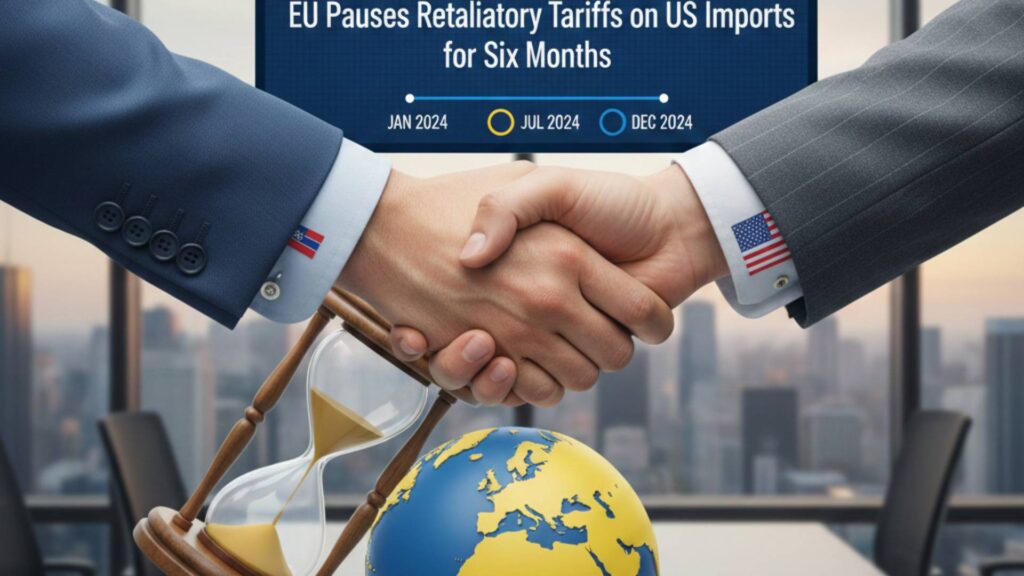
Executive Summary: The European Union has formally instituted a six-month standstill on its retaliatory tariff package targeting over €2.8 billion ($3.1 billion) in high-profile United States exports. Enacted by the European Commission Directorate-General for Trade, this suspension delays planned duty escalations on politically sensitive American consumer and industrial goods—including Kentucky bourbon, Harley-Davidson motorcycles, powerboats, and agricultural machinery. The tactical pause extends diplomatic runway for bilateral negotiations with the Office of the United States Trade Representative (USTR) surrounding the Global Arrangement on Sustainable Steel and Aluminum (GSA), deferring a transatlantic tariff escalation while preserving Brussels’ statutory rights to snap countermeasures back into effect if negotiations falter.
Origins of the Transatlantic Tariff Standoff: Section 232
The legal genesis of the dispute traces back to 2018, when the U.S. Department of Commerce invoked Section 232 of the Trade Expansion Act of 1962, declaring imported European steel and aluminum a national security risk. Washington imposed blanket 25% import tariffs on foreign steel and 10% on aluminum.
The European Union challenged these duties before the World Trade Organization (WTO) Dispute Settlement Body, arguing that national security pretexts were being deployed as unnotified protectionist safeguard measures. In response, Brussels enacted a two-stage rebalancing package under EU Regulation 2018/886, imposing punitive import duties on targeted U.S. goods carefully selected to inflict political pressure across congressional battleground districts.
While a temporary Tariff-Rate Quota (TRQ) system replaced the blunt Section 232 tariffs in 2021, the underlying legal dispute remained unresolved, setting up periodic legislative deadlines where scheduled tariff hikes automatically trigger unless explicitly paused by the European Council.
This dynamic mirrors the broader unilateral tariff shifts analyzed in our report on unilateral import tariffs and international trade friction, alongside multilateral trade negotiations covered in bilateral tariff eliminations and trade treaty dynamics.
Targeted Product Basket: EU Retaliatory Duties Breakdown
The table below outlines the primary American export lines targeted under the European Union’s rebalancing measures, illustrating the strategic economic footprint of the suspended tariffs:
| Target Product Category | Key Exporting States / Brands | Scheduled Retaliatory Duty Rate | Annual EU Trade Volume | Current Regulatory Status |
|---|---|---|---|---|
| Distilled Spirits (Bourbon & Rye) | Kentucky, Tennessee (Jack Daniel’s, Jim Beam) | 50% (Escalating from 25%) | €450 Million | Suspended under 6-month truce |
| Motorcycles (>500cc Displacement) | Wisconsin, Pennsylvania (Harley-Davidson) | 50% punitive tariff | €380 Million | Suspended under 6-month truce |
| Agricultural Goods (Corn & Soy) | Midwestern farm belt | 25% ad valorem duty | €520 Million | Suspended under 6-month truce |
| Boats & Recreational Watercraft | Florida, Minnesota, Wisconsin | 25% – 50% compound rate | €260 Million | Suspended under 6-month truce |
| Industrial & Construction Steel | Indiana, Ohio, Pennsylvania | Reciprocal 25% rebalancing duty | €1.2 Billion | Managed via TRQ quota allocation |
The Negotiating Core: GSA and Carbon Border Adjustment (CBAM)
The rationale for the six-month extension centers on finalizing the Global Arrangement on Sustainable Steel and Aluminum (GSA). Both Washington and Brussels seek to establish a joint carbon-based tariff club designed to penalize steel produced through high-emission blast furnace methods—predominantly originating from China.
However, transatlantic negotiators remain locked in regulatory disagreement over structural tax alignment:
- CBAM Compliance vs. U.S. Subsidies: The EU insists that any transatlantic trade club must comply with the EU Carbon Border Adjustment Mechanism (CBAM), which levies import carbon fees based on direct emissions trading (EU ETS). The United States lacks an explicit federal carbon pricing regime, relying instead on clean-energy tax subsidies under the Inflation Reduction Act (IRA).
- WTO Compatibility: Brussels insists on a WTO-compliant tariff structure that does not discriminate purely based on geography, whereas Washington favors direct targeted external tariffs against non-market steel production.
- Quota Administration Friction: The current TRQ arrangement requires European exporters to navigate cumbersome customs paperwork and quarterly volume caps, generating portside backlogs similar to automotive terminal bottlenecks analyzed in our coverage of customs port clearance backlogs and inventory bottlenecks.
Economic Implications of a Snapback Trigger
By electing to suspend rather than repeal Regulation 2018/886, the European Commission retains legal leverage. If negotiations do not yield a binding multilateral agreement by the end of the six-month window, the retaliatory tariff basket will automatically snap back into force without requiring new legislative approval from the European Parliament or Council.
For affected U.S. manufacturers, the six-month reprieve provides temporary relief but does not eliminate long-term supply chain uncertainty. During previous tariff waves, American distillers lost over 20% of their European market share to UK scotch and Irish whiskey producers, forcing corporate parent companies to absorb tariff costs into gross margins to prevent permanent retail shelf-space displacement.
Frequently Asked Questions
What are the EU retaliatory tariffs on US imports?
The EU retaliatory tariffs are a package of punitive customs duties targeting over €2.8 billion in American products—including bourbon whiskey, motorcycles, motorboats, and agricultural goods—instituted in response to U.S. Section 232 tariffs on European steel and aluminum.
Why did the European Union pause the retaliatory tariffs for six months?
The European Commission paused the tariffs to provide diplomatic room to negotiate the Global Arrangement on Sustainable Steel and Aluminum (GSA) with the U.S. Trade Representative. The standstill prevents a trade war escalation while negotiators attempt to align green steel standards and carbon border policies.
What happens if the US and EU fail to reach a deal within six months?
If no formal agreement or further extension is reached, the retaliatory tariffs will automatically snap back into effect, imposing duties of up to 50% on targeted American imports without requiring a new legislative vote in Brussels.
Are US steel tariffs currently in effect for European exporters?
Blanket 25% steel tariffs were suspended in 2021 and replaced by a Tariff-Rate Quota (TRQ) system, allowing historical volumes of European steel and aluminum to enter the U.S. duty-free, with tariffs applying only to imports exceeding quota thresholds.