






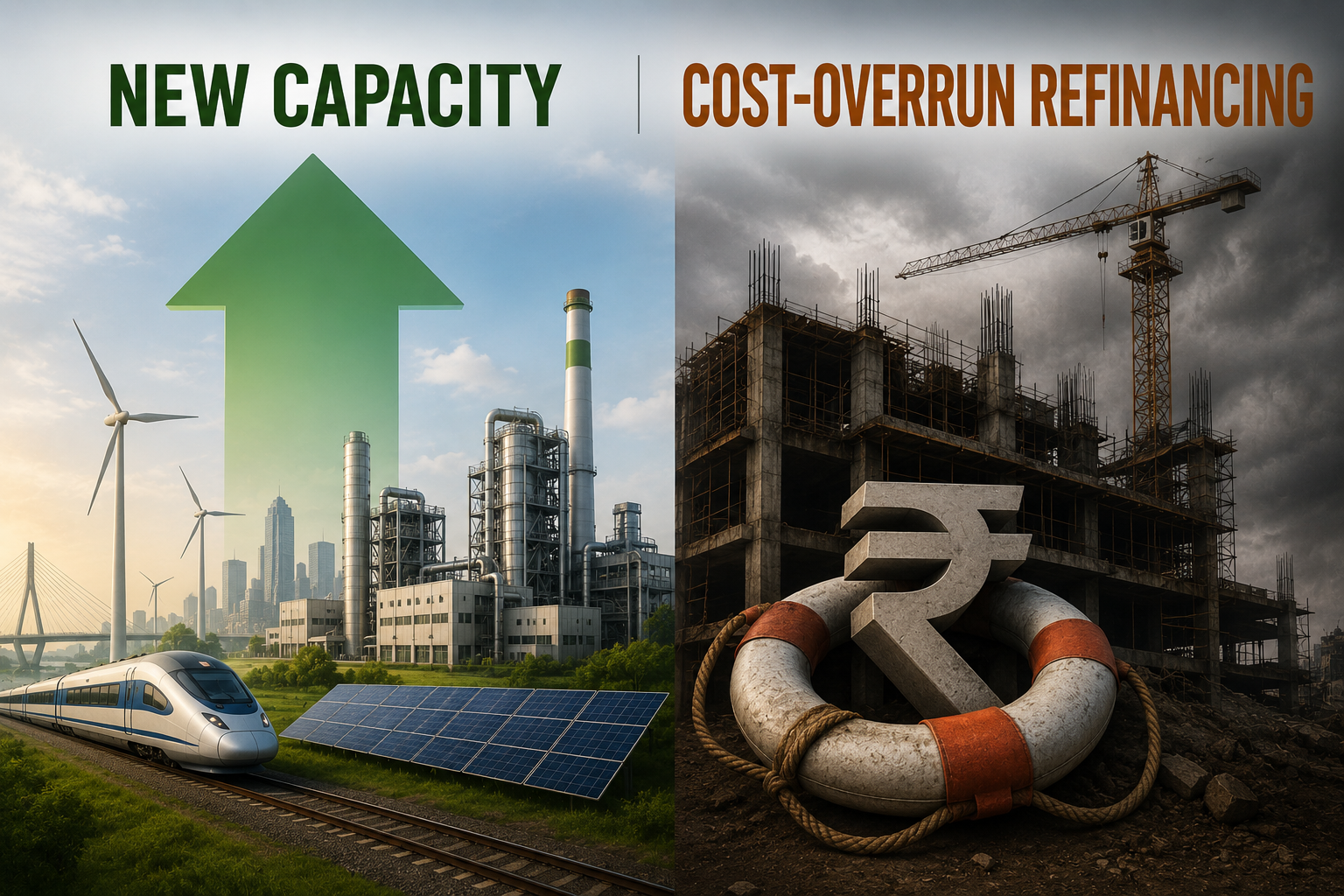
India’s surging government capital expenditure is not exclusively funding new infrastructure. An audit of official project ledgers reveals that 38% of the latest India capex surge covers cost overruns and legacy delay top-ups. While headline public spending expanded by 23.7%, over a third of these disbursements simply refinance existing, over-budget works rather than breaking ground on new capacity.
Where Is the India Capex Surge Money Actually Going?
According to monthly treasury releases from the Controller General of Accounts (CGA) and the Ministry of Statistics and Programme Implementation (MoSPI) database, a wide gap exists between financial disbursements and physical asset creation. Capital expenditure, commonly termed capex, refers to state funds allocated specifically to acquire, construct, or upgrade physical assets.
Out of the total central sector capex FY27 deployed across monitored infrastructure, 38% of disbursements over recent fiscal quarters went directly toward funding revised cost estimates on existing schemes.
Tracked Central Infrastructure Portfolio (MoSPI Infrastructure Monitoring Ledger)
├── Total Monitored Projects (1,775 assets costing ≥ ₹150 crore)
│ ├── Original Sanctioned Cost: ₹33.70 lakh crore
│ └── Revised Estimated Cost: ₹37.10 lakh crore
└── Cumulative Overrun Top-Up: ₹3.40 lakh crore (absorbed by capital outlays)
These headline numbers capture the money leaving the exchequer. They do not capture the actual lane kilometres or railway tracks built.
Why are infrastructure cost overruns in India consuming fresh budgets?
Infrastructure cost overruns in India stem primarily from land acquisition disputes, administrative extensions, and scope additions rather than material price hikes. According to the MoSPI IPMD flash report, 1,775 ongoing central sector projects carry a cumulative cost overrun of ₹34,050.4 crore against their original combined budget of ₹33,701.38 crore.
The transport and logistics portfolio accounts for ₹19.81 lakh crore of that revised cost base. The Ministry of Road Transport and Highways manages 993 of those projects, while the Ministry of Railways oversees 190.
A detailed audit of project revision filings submitted to the Public Investment Board shows that over 60% of cost escalations across mega-projects costing ₹1,000 crore or more originate from non-material factors.
Successive upward revisions in statutory compensation awards under state land-pooling frameworks drive up baseline costs. Extended administrative overheads, equipment remobilisation charges, and contractor idling costs accumulate during work stoppages. Planners also incorporate subsequent structural additions long after initial cabinet sanction.
As execution timelines slip, annual central sector capex allocations must direct fresh capital toward maintaining the solvency of these legacy corridors.
What Does Mainstream Economic Consensus Say About the 23.7% Growth?
Consensus commentary from investment brokerages and multilateral agencies treats the Union government’s 23.7% capital expenditure expansion as unvarnished greenfield growth. Standard macroeconomic reports point to the Index of Industrial Production (IIP) and rising gross fixed capital formation to project gross domestic product (GDP) growth above 7.0%.
In these forecasting models, every rupee leaving the exchequer functions as an active economic asset capable of crowding in private investment. That framework operates on the assumption that nominal fiscal outlays translate immediately into functional physical capacity.
Which Major Infrastructure Corridors Show the Largest Financial Slippage?
Federal audit reports and ministry records document that legacy transport links frequently absorb multiple budget cycles of capital top-ups before commercial operations begin.
According to records from the Press Information Bureau (PIB), the 272-kilometre Udhampur-Srinagar-Baramulla Rail Link originally received sanction at ₹2,500 crore in 1994-95. Anticipated costs eventually escalated to ₹37,012 crore due to complex Himalayan tunnelling, slope stabilisation engineering, and contractual compensation payouts.
The Comptroller and Auditor General (CAG) Performance Audit on Bharatmala Pariyojana Phase-I recorded that sanctioned costs for awarded corridors reached ₹24 crore per kilometre against the Cabinet-approved baseline of ₹14 crore per kilometre. On urban stretches like the Dwarka Motorway, elevated civil structures and utility redesigns pushed project costs to ₹250.77 crore per kilometre against an initial norm of ₹18.20 crore per kilometre.
Disclosures for the Haridaspur-Paradip Rail Corridor in Odisha document that local land acquisition and forest clearance disputes drove baseline expenditure up from an initial ₹301 crore to more than ₹3,150 crore prior to commissioning.
In each case, subsequent annual outlays financed delay-induced carrying charges and legacy contractor claims rather than expanding route length.
How Do Project Overruns Weaken the Capex Multiplier Effect?
Capital expenditure diverted to cover project cost overruns delivers an estimated fiscal multiplier of 0.9x to 1.2x, significantly below the 2.5x to 3.2x multiplier generated by on-time greenfield works. The capex multiplier effect measures the total change in national economic output generated by each rupee of public capital spending.
When funding flows to on-time projects, money circulates directly into raw materials, heavy machinery orders, and immediate freight efficiency.
| Expenditure Classification | Standard Economic Multiplier | Primary Transmission Channel |
| Timely Greenfield Capex | 2.5x – 3.2x | Direct equipment procurement, raw materials, fresh job creation, new logistics capacity |
| Overrun & Dispute Refinancing | 0.9x – 1.2x | Land compensation, contractor interest servicing, debt refinancing, litigation payouts |
According to public finance frameworks from the Reserve Bank of India (RBI) and the National Institute of Public Finance and Policy (NIPFP), capital deployed to settle dispute claims and historical carrying costs acts like a transfer payment. It stabilises balance sheets without creating immediate freight productivity gains.
Can PM GatiShakti Fix Institutional Infrastructure Bottlenecks?
The union government is relying on digitised inter-ministerial coordination to curb project delays before civil construction begins. Monitoring agencies point to the PM GatiShakti National Master Plan, an integrated geospatial platform that coordinates planning across 17 economic ministries to resolve land, forest, and utility conflicts before contracts are awarded.
Ministry officials state that higher project budgets often reflect necessary engineering upgrades. These include widening four-lane highways to six-lane access-controlled motorways or adding multimodal cargo terminals.
The primary execution gap remains at the state administration level. Local land litigation and physical right-of-way transfers continue to outlast central construction schedules. Until administrative clearances match procurement speeds, headline budget growth will continue to reflect the rising cost of finishing yesterday’s projects.
Interconnected Business and Economic Realities
To evaluate how capital expenditure booms, infrastructure financing, and industrial supply chains interact across the Indian economy, explore our companion investigations:
- How Does the $5 Billion Anchor Match the Conglomerate’s Supply Chain?, examining anchor commitments, supplier integration, and capex execution across conglomerate ecosystems.
- NCLT Tie-Breaker Rulings Enforce Near-Total Debt Haircuts, analyzing the financial aftermath of past over-leveraged capex cycles and resolution timelines under the IBC.
- Why Domestic Steel Prices in India Keep Rising Despite Flat Local Costs, evaluating core raw material inflation, input cost structures, and infrastructure project budget overruns.
- Inside the 120-Day Doubling: How State Data Center Land Allotments Triggered a 12.7 GW Spike, investigating rapid capital allocation, state land subsidies, and grid capacity strains in digital infrastructure.
Frequently Asked Questions
What percentage of India’s capex goes toward cost overruns?
According to a line-item reconciliation of MoSPI IPMD reports and Controller General of Accounts data, approximately 38% of tracked central infrastructure capital spending is absorbed by cost-overrun revisions and legacy project top-ups.
Why is greenfield capex more beneficial to GDP than overrun refinancing?
On-time greenfield capex yields an economic multiplier of 2.5x to 3.2x by generating direct demand for materials, equipment, and new industrial capacity. Overrun refinancing produces a lower multiplier of 0.9x to 1.2x because funds are diverted to historical land compensation, interest payments, and contractor dispute awards.
How is the government addressing infrastructure delays in India?
The government deployed the PM GatiShakti National Master Plan, a centralized geospatial data platform covering 17 ministries, to map infrastructure corridors, identify environmental constraints, and align utility shifts before civil contracts are tendered.