






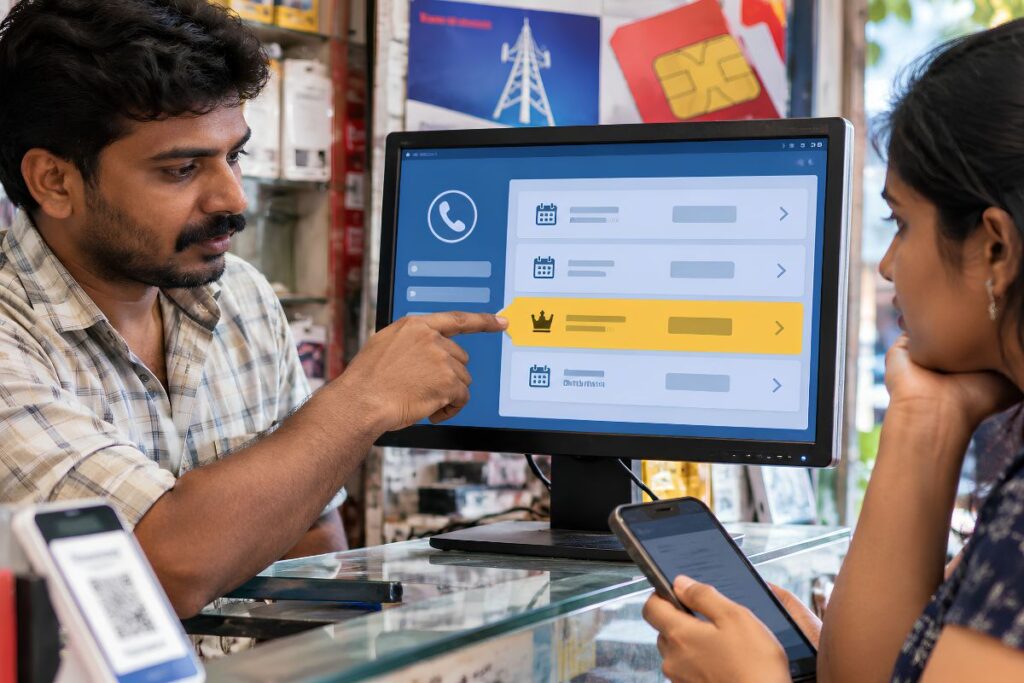
When a mobile subscriber switches from recurring monthly top-ups to a 365-day plan through a carrier app, the offline recharge shop commission collapses by roughly 60% per customer over a year, while eliminating twelve store visits that drive neighborhood retail trade.
How Much Offline Recharge Shop Commission Is Lost to 365-Day App Plans?
A local retailer loses between ₹85 and ₹180 in annual commission on every subscriber who migrates from monthly counter recharges to a carrier application.
For over two decades, independent telecom counters operated on transaction frequency. A telecom counter is an independent, multi-brand neighborhood shop licensed to process mobile plan renewals and SIM transactions through merchant point-of-sale software. Under standard distributor fee schedules managed through specialized dealer interfaces like Airtel Mitra from Bharti Airtel Limited and JioPOS Plus from Reliance Jio Infocomm Limited, shopkeepers earn between 3% and 4% on recurring 28-day prepaid packs. On a standard monthly tier priced between ₹299 and ₹349, a subscriber recharging thirteen times a year generates roughly ₹120 to ₹180 in cumulative annual retailer commissions.
That revenue breaks down when that user transitions to an annual pack. If a customer buys a 365-day tier, priced between ₹3,599 and ₹3,999, directly over the counter, dealer rate schedules apply reduced percentage margins or flat caps, paying the merchant between ₹35 and ₹50.
If the customer completes that recharge digitally via consumer platforms like the MyJio or Airtel Thanks apps, the physical retailer receives zero.
Across a localized base of 500 regular prepaid customers, converting a quarter of those users to direct digital annual plans removes tens of thousands of rupees in baseline gross margin from a small merchant’s operating ledger every year.
Why Does Losing Monthly Recharge Foot Traffic Threaten Neighborhood Kiranas?
Cutting monthly recharge visits deprives small stores of critical foot traffic, costing merchants up to ₹2,500 per customer each year in lost grocery and accessory sales.
A kirana is a small, traditional family-run neighborhood grocery and general retail store that serves local communities across India. In tier-2 cities, tier-3 towns, and rural markets, prepaid mobile top-ups serve primarily as a customer acquisition tool designed to draw people through the door.
According to trade assessments by the All India Mobile Retailers Association (AIMRA), independent multi-brand outlets rely on foot traffic from monthly telecom transactions to sustain non-telecom sales. A customer visiting a counter every 28 days to keep a phone connection active frequently buys secondary goods: phone cables, packaged snacks, confectionery, stationery, and household essentials.
When a subscriber buys a 365-day plan online, twelve customer visits vanish from the store’s annual foot-traffic count. Trade data gathered across local commercial districts indicates that losing those twelve physical visits removes between ₹1,200 and ₹2,500 in attached high-margin retail sales per converted customer. The loss of store visits causes far more damage to a retailer’s bottom line than the lost telecom commission itself.
Why Do Telecom Distributor Monthly Slab Targets Penalize Annual Plan Sales?
Distributor incentive systems measure retail performance by transaction count rather than total cash value, penalizing store owners who sell long-validity recharges.
A distributor monthly slab target is a volume quota set by telecom distribution agencies that requires an agent to process a specific count of unique mobile numbers each month to unlock tiered financial bonuses. Telecom distribution networks enforce these quotas through carrier Territory Sales Managers. A single ₹3,599 transaction carries the exact same weight on a dealer’s monthly performance scorecard as a basic entry-level voice pack: one recharge.
If a merchant sells twenty 365-day recharges to loyal customers at the counter, those twenty phone numbers vanish from the shop’s active transaction pool for the following twelve months. The merchant must then locate twenty new customers each month simply to maintain their minimum quota and protect their base commission rate across all transactions. The carrier incentive system punishes physical vendors for selling the long-validity tiers that telecom marketing teams promote.
Why Are Telecom Operators Bypassing Physical Retailers for Digital Recharges?
Carriers use app-exclusive cashbacks and discounts on annual plans to direct consumers away from physical counters and cut distribution overhead.
Selling plans through consumer self-service apps removes physical distribution expenses and intermediary commissions from company balance sheets. Quarterly financial disclosures from Bharti Airtel Limited and Reliance Industries Limited document continuous operational programs to reduce sales, general, and administrative expenses by moving customers onto digital billing paths.
To accelerate direct-to-consumer adoption, carriers build high-value annual tiers with app-exclusive perks:
- In-app merchant discount coupons and extended streaming memberships unavailable on merchant point-of-sale systems.
- Direct wallet cashbacks and unified payment incentives accessible only through proprietary self-care portals.
- Exclusive high-speed data vouchers bundled into annual app renewals.
Dealer platforms cannot match these app-only promotions. When subscribers compare an in-app renewal incentive against the counter rate card, the carrier’s digital channel offers a lower net price, pulling sales away from the local store that originally set up the SIM card.
How Are Local Recharge Counters Adapting to the Decline of Telecom Revenue?
Independent store owners are replacing telecom counters with cash withdrawal kiosks, utility billing portals, and domestic remittance services to stay open.
Faced with declining recharge revenue, thousands of independent shops have reconfigured their retail floor space into local financial services counters. Merchants now prioritize the Aadhaar-enabled Payment System (AePS), domestic cash transfers, micro-ATM withdrawals, and bill payment services run through infrastructure governed by the National Payments Corporation of India (NPCI). The Aadhaar-enabled Payment System is a bank-led financial model that lets customers carry out basic banking operations using their national identity number and fingerprint verification at local point-of-sale terminals.
For neighborhood merchants, telecom point-of-sale tools are shifting from a central revenue anchor to a secondary feature. As consumer applications capture annual subscriptions, local shopkeepers are stepping away from the mobile carrier sales model that sustained them for decades.
Frequently Asked Questions
What does an offline retailer earn when a customer buys a 365-day recharge in-store?
A physical retailer earns roughly ₹35 to ₹50 on an in-store 365-day recharge because telecom distributor rate cards apply reduced commission percentages or flat caps to high-denomination packs. If that customer recharges the annual pack via a carrier app, the retailer receives ₹0.
Why do retailer distributor incentives discourage selling annual mobile plans?
Distributor incentive programs require store owners to meet monthly quotas based on the number of unique mobile numbers recharged, rather than total sales revenue. A single annual recharge counts as only one monthly transaction and removes that subscriber from the store’s transaction pool for an entire year.
How much secondary retail revenue does a shop lose when a customer stops visiting for monthly top-ups?
According to retail trade surveys from merchant associations, losing twelve monthly recharge visits eliminates between ₹1,200 and ₹2,500 in attached grocery, accessory, and convenience purchases per subscriber each year.