






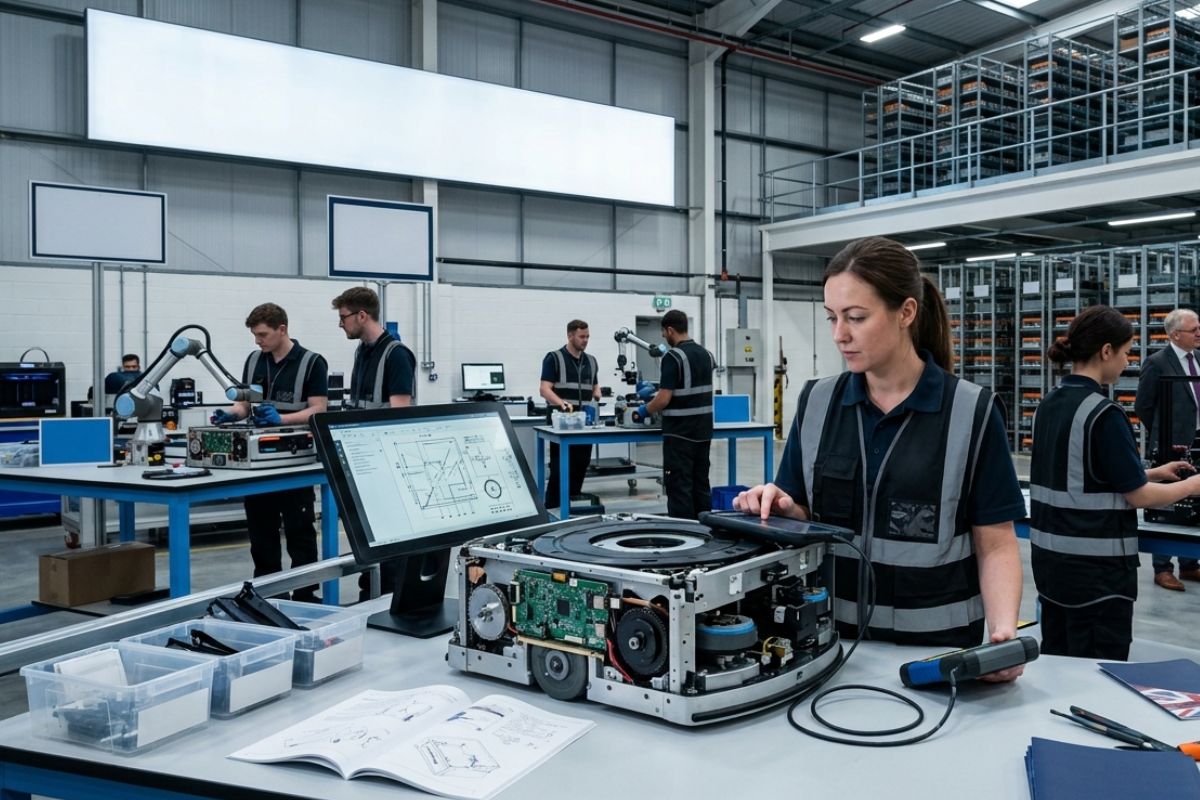
Foreign warehouse robotics suppliers in the UK restrict third-party repairs through software diagnostic locks and restricted spare parts. This crisis over UK warehouse robotics right to repair forces mandatory vendor service contracts, driving up annual maintenance costs for logistics operators by 30 to 40 per cent and locking local independent engineers out of the market.
How Do Software Locks Block Independent Engineers in UK Warehouses?
Foreign suppliers use encrypted authentication keys within Robot Management Systems (RMS) that prevent uncertified UK technicians from clearing basic error logs. Without remote server authorisation from the original manufacturer, physical repairs remain ineffective and machinery stays idle.
Autonomous Mobile Robots (AMRs), wheel-based industrial robots that navigate logistics facilities independently to transport goods, operate on proprietary fleet-management software platforms called Robot Management Systems (RMS).
When an AMR encounters a motor stall or optical sensor fault, clearing the operational error code requires a digital software handshake alongside any physical repair.
Independent UK automation contractors report that foreign manufacturers require encrypted remote server authentication keys to reset basic system error logs. Without these digital keys, hardware replacements cannot be calibrated or cleared.
The machinery remains non-operational, a software-enforced lockout detailed in research by the Right to Repair Europe Coalition on digital locks in automated commercial systems.
How Much Do Vendor-Only SLAs Add to Maintenance Costs for Warehouse Robotics in the UK?
Mandatory vendor service level agreements (SLAs) add a 30 to 40 percent premium to annual warehouse robotics maintenance costs. Procurement records show operators pay £3,500 per robot annually under vendor contracts, compared to £2,500 for equivalent independent servicing.
According to reviewed procurement contracts and internal financial disclosures, logistics operators pay an average of £3,500 per unit annually for routine maintenance under mandatory vendor contracts. Independent industrial automation firms estimate equivalent physical coverage at £2,500 per unit: a cost increase of 40 per cent, moving from £2,500 to £3,500. Fulfilment Centres
For a distribution facility operating 300 autonomous units, annual maintenance spending increases from £750,000 under open independent servicing to £1,050,000 under original equipment manufacturer contracts.
These mandatory agreements bundle essential software patches with routine mechanical servicing, according to commercial equipment industry analyses from Logistics UK. Operators cannot decline the physical maintenance package without losing access to core software updates.
Why Are UK Fulfilment Centres Replacing Open Conveyor Systems with Robotic Fleets?
UK fulfilment centres are replacing legacy conveyor belts with autonomous mobile robot fleets to increase storage density and operational flexibility. However, this shift replaces open industrial hardware with proprietary closed systems controlled entirely by foreign vendors.
Traditional UK distribution facilities relied on standardised conveyor belts and sorting machinery.
These legacy systems ran on open industrial computing frameworks, such as Siemens programmable logic controllers. Local engineering contractors easily sourced replacement parts and serviced these systems without manufacturer intervention.
Modern fulfilment hubs are replacing fixed conveyor infrastructure with autonomous mobile fleets. This architectural shift transfers long-term operational control from facility managers to original hardware vendors.
How Do Overseas Server Validations Delay Hardware Repairs on UK Warehouse Floors?
Replacing physical components like motors or optical sensors on warehouse robots requires live firmware handshake validation from overseas manufacturer servers. If server clearance is delayed, routine 15-minute mechanical part swaps turn into multi-hour operational outages.
Physical components such as drive motors and optical light-detection modules carry strict digital restrictions.
Replacing a worn wheel assembly requires a live firmware handshake validation from overseas cloud servers managed directly by the hardware manufacturer. If the remote server does not authorise the replacement part immediately, the robot remains disabled.
Fulfilment centre incident logs show this remote validation loop turns routine 15-minute mechanical swaps into multi-hour operational delays, a systemic operational vulnerability highlighted by the Chartered Institute of Logistics and Transport.
Does the UK Right to Repair Law Protect Commercial Warehouse Machinery?
Current UK right-to-repair legislation does not protect commercial warehouse machinery because statutory provisions apply strictly to consumer goods. Under the Ecodesign for Energy-Related Products and Energy Information Regulations 2021, business-to-business industrial equipment remains exempt.
UK statutory protections do not extend to commercial warehouse machinery.
The Ecodesign for Energy-Related Products and Energy Information Regulations 2021 established a legal right to repair in the UK. However, these rules apply strictly to consumer goods such as washing machines and televisions, leaving business-to-business industrial equipment exempt.
Logistics operators seeking relief under Section 18 of the Competition Act 1998 face high legal thresholds to prove abuse of dominance in commercial aftermarket servicing.
This closed servicing model reflects broader practices in industrial technology, where companies restrict repair access to authorised service networks.
Equipment manufacturers argue these controls are necessary for operational safety and system security.
Public compliance documentation from suppliers like Geek+ emphasises that restricted maintenance access is necessary to satisfy safety frameworks. Manufacturers cite the international safety standard ISO 3691-4:2023 for driverless industrial trucks, arguing that uncertified repairs risk voiding CE and UKCA certifications and compromising network security.
Uncertified repairs can also void commercial building insurance policies and compromise proprietary software architecture.
How Are UK Logistics Providers Negotiating Repair Rights in New Tenders?
To curb rising maintenance expenses, UK logistics providers are writing open API access and 24-hour local spare-parts guarantees directly into new procurement tenders. Operators are also introducing contractual clauses that grant internal engineering teams self-maintenance rights once initial warranty periods expire.
To manage ongoing operational expenses, third-party logistics providers in the UK are altering their purchasing strategies.
New tender documents require vendors to grant open application programming interface access and guarantee local spare-parts delivery within 24 hours.
Some operators now insist on contract clauses that allow internal engineering teams to perform routine mechanical repairs after initial warranty periods expire.
The balance between operational uptime and vendor control will shape the next generation of UK warehouse contracts.
Frequently Asked Questions
What is causing the repair lockout in UK warehouse robotics?
Foreign robotics manufacturers restrict maintenance by using encrypted software keys within Robot Management Systems (RMS) and withholding replacement spare parts. Independent UK engineers cannot clear system error codes or validate replacement hardware without live authentication from overseas vendor servers.
How much do mandatory OEM maintenance contracts cost UK logistics hubs?
According to reviewed procurement contracts, required vendor service agreements cost an average of £3,500 per robot annually. This represents a 40 per cent premium over independent industrial automation servicing, which costs approximately £2,500 per unit per year.
Are commercial warehouse robots covered under the UK’s 2021 Right to Repair regulations?
No. The Ecodesign for Energy-Related Products and Energy Information Regulations 2021 strictly cover consumer appliances like televisions and washing machines. Business-to-business industrial machinery, including autonomous mobile robots, is exempt from these statutory repair protections.
Why do robotics manufacturers restrict independent repairs on warehouse fleets?
Manufacturers cite safety standards like ISO 3691-4:2023 for driverless industrial trucks, operational cyber security, and intellectual property protection as reasons for restricted maintenance networks. They argue uncertified third-party repairs risk voiding safety certifications and compromising cloud network security.