






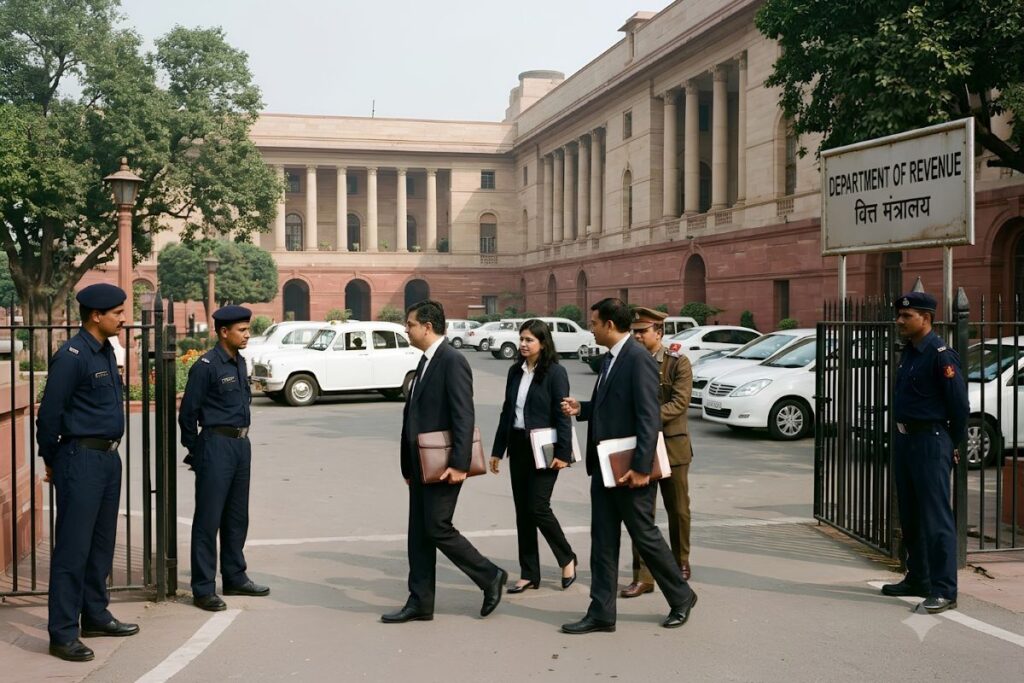
India’s largest conglomerates rarely criticize government policy in public because private negotiations yield better commercial results than open debate. By maintaining permanent regulatory teams in New Delhi, incumbent firms secure tailored changes to tariffs, subsidies, and compliance rules, creating a competitive moat that smaller domestic and foreign rivals cannot afford to match.
How Does India Inc Influence Government Policy Without Public Debate?
Top Indian corporations shape government policy by submitting technical representations directly to senior bureaucrats after broad rules are announced, securing narrow tariff or subsidy revisions through official Gazette notifications. Public silence at business summits coexists with continuous behind-the-scenes rule shaping.
Two documented policy tracks show how post-announcement revisions work in practice. Under the Production-Linked Incentive (PLI) scheme, a federal subsidy program that pays manufacturers cash incentives based on incremental domestic sales, the Ministry of Electronics and Information Technology (MeitY) issued repeated Empowered Committee addenda and subsequent guideline amendments after the April 1, 2020 rollout, altering net-sales definitions, group-company revenue baselines, and compliance timelines.
Customs tariff schedules follow the same pattern. Following representations from the India Cellular & Electronics Association (ICEA) over classification disputes on parts taxed under the residual “others” category, the Central Board of Indirect Taxes and Customs (CBIC) issued Notification No. 09/2024-Customs on January 30, 2024, cutting Basic Customs Duty on specified mobile phone components from 15% to 10% and setting duty to nil on their inputs.
In July 2026, CBIC applied the same surgical approach through Notifications No. 25/2026-Customs, 26/2026-Customs, and 27/2026-Customs. Those orders granted targeted duty exemptions until March 2029 on specialized display components, wireless charging coils, and 85 categories of lithium-ion cell machinery.
When officials accept these private technical arguments, relief arrives as narrow product-code exemptions or extended compliance windows rather than broad policy reversals.
Why Does Regulatory Opacity Act as a Competitive Moat?
Regulatory opacity, a system where complex rules are modified through unpublished bilateral consultations rather than open public rulemaking, gives large incumbents a cost advantage because only top conglomerates can afford full-time policy teams in New Delhi.
Unlike the United States, India has no statutory lobbying disclosure law. A private member’s Disclosure of Lobbying Activities Bill lapsed in Parliament without passage, leaving corporate policy advocacy to operate through in-house government-affairs units, legal retainers, and trade associations without public registration.
Financial filings show the advisory budgets available to top-tier conglomerates. According to corporate annual report disclosures compiled on legal and professional charges, Reliance Industries reported ₹1,486 crore, and Sun Pharmaceutical Industries reported ₹2,023 crore in annual legal and professional expenses, while Tata Industries’ FY 2025–26 annual report recorded ₹380.63 crore under legal and professional fees.
These budgets fund permanent regulatory specialists, tax counsel, and policy analysts who track draft notifications daily and prepare technical dossiers for line ministries. Mid-sized companies and new foreign entrants lack that permanent presence in the capital, leaving them to absorb sudden cost increases after rules take effect.
How Do Industry Chambers Filter Corporate Demands?
Apex industry chambers, such as the Confederation of Indian Industry (CII) and the Federation of Indian Chambers of Commerce and Industry (FICCI), pair public praise at economic summits with detailed, technical tax and tariff requests in private pre-budget submissions.
Commentary on Indian business-state relations often attributes corporate restraint at annual conferences to fear of regulatory retaliation. That framing misses how apex chambers aggregate and filter member priorities before approaching the Finance Ministry.
In public forums, chamber leaders emphasize alignment with national growth targets. In formal submissions, however, those same organizations deliver granular technical demands: the CII Annual Report 2025–26 and FICCI’s indirect tax pre-budget proposals document specific requests to the Department of Revenue targeting inverted duty structures, customs valuation disputes, and sector-specific tariff parity.
Smaller enterprises struggle to win structural relief through the same channels. Ahead of recent fiscal cycles, Federation of Indian Micro and Small & Medium Enterprises (FISME) Secretary General Anil Bhardwaj noted that existing Goods and Services Tax (GST) refund formulas and compliance rules leave smaller manufacturers with unrefunded input tax credits on capital goods and heavy reconciliation burdens, broad operational issues rather than single-product tariff lines.
How Do Discretionary Policy Tweaks Lock Out Smaller Challengers?
When policy relief arrives through case-by-case approvals, phased manufacturing timelines, or narrow tariff exemptions instead of uniform rules, incumbent manufacturers consolidate market share while smaller rivals face higher capital and compliance costs.
Market data from the PLI-backed electronics sector shows this consolidation. According to Counterpoint Research’s Make in India tracking and FY 2026 industry shipment figures, domestic electronics manufacturing services (EMS) firms led by Dixon Technologies expanded their combined smartphone production share to roughly 28% in FY 2026, up from 9% in Q2 2024.
Overall subsidy distribution reflects similar concentration. According to PLI scheme disbursement data, 70% of the ₹28,748 crore disbursed across 14 sectors through December 2025 went to just two industries: electronics and pharmaceuticals.
For smaller manufacturers and outside investors, discretionary rules create structural cost disadvantages. As Global Trade Research Initiative (GTRI) founder Ajay Srivastava wrote in his analysis of Indian manufacturing competitiveness, complex compliance regimes, shifting tariff structures, and domestic borrowing rates of 9% to 10%, compared with 4% to 5% in China, penalize smaller firms, pushing them toward low-margin assembly rather than deep domestic manufacturing.
Why Do Corporate Boards and Ministries Prefer Closed-Door Consultations?
Corporate boards treat quiet regulatory engagement as mandatory risk management under securities governance rules, while government ministries rely on confidential consultations to gather proprietary factory-level cost data without triggering market speculation.
Under Regulation 21 of the Securities and Exchange Board of India (SEBI) Listing Obligations and Disclosure Requirements (LODR) framework, the top 1,000 listed companies must maintain board-level Risk Management Committees to identify and mitigate external sectoral and regulatory threats. For listed firms in regulated sectors, such as telecom, banking, and energy, boards view public confrontation with the executive branch as an avoidable commercial risk.
From the administration’s side, closed-door consultations serve a direct operational purpose. When the Ministry of Commerce and Industry convened stakeholder consultations on bilateral trade negotiations with CII, FICCI, ASSOCHAM, and ICEA, officials sought confidential supply-chain and pricing figures that companies will not share in open media.
Ahead of the 2027–28 budget cycle, the Finance Ministry’s review of 118 expiring customs duty exemptions similarly relies on line ministries collecting product-level cost data directly from domestic producers. Yet even when confidential talks fix genuine technical bottlenecks, the result stays the same: private access outweighs public debate, and silence on the main stage preserves leverage in the back room.
Frequently Asked Questions
Why don’t big Indian conglomerates criticize government policy in public?
Large Indian conglomerates avoid public criticism because private bilateral negotiations with ministries secure targeted tariff cuts, subsidy amendments, and compliance extensions without risking commercial friction. Under SEBI LODR Regulation 21, top 1,000 listed companies also maintain Risk Management Committees tasked with minimizing external regulatory exposure.
Is corporate lobbying legal and regulated in India?
Corporate policy advocacy through in-house government-affairs teams, legal counsel, and industry chambers like CII and FICCI is legal in India, but no statutory lobbying disclosure law governs it. A private member’s Disclosure of Lobbying Activities Bill lapsed in Parliament without passage, meaning corporate representations to ministries are not publicly registered.
How much do major Indian corporations spend on legal and professional advisory services?
Annual report disclosures show top conglomerates spend hundreds of crores on legal and professional retainers that support regulatory tracking and compliance. Reliance Industries reported ₹1,486 crore and Sun Pharmaceutical Industries reported ₹2,023 crore in annual legal and professional charges, while Tata Industries recorded ₹380.63 crore in FY 2025–26.
How do discretionary policy amendments affect smaller Indian manufacturers?
Case-by-case tariff exemptions and complex compliance rules favor large incumbents with permanent Delhi regulatory teams while raising costs for micro, small, and medium enterprises (MSMEs). According to PLI disbursement data through December 2025, 70% of the ₹28,748 crore paid out across 14 sectors went to just electronics and pharmaceuticals, while MSMEs face 9% to 10% borrowing rates and unrefunded GST input credits.