






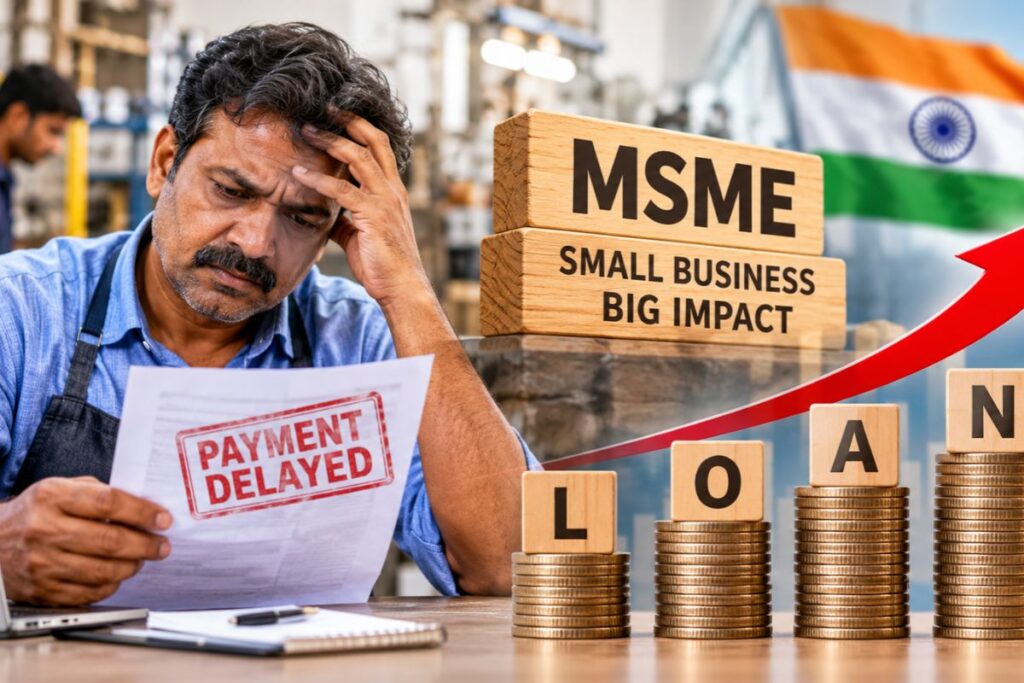
Small business borrowing in India is rising rapidly because micro-enterprises take high-interest personal loans to pay daily wages and buy raw materials while waiting 90 to 120 days for delayed payments from large corporate buyers and public sector undertakings, turning reported credit growth into a liquidity patch rather than expansion capital.
Why Are Micro-Suppliers Borrowing on Personal Credit to Cover Delayed Corporate Payments?
Micro-enterprises borrow against personal credit lines because traditional business loans demand repayments within 30 days, while corporate buyers routinely take 90 to 120 days to settle invoices.
Across industrial clusters in India, tier-3 component suppliers and micro-contractors borrow against their personal Permanent Account Numbers (PAN), a ten-character tax identifier issued by the Indian Income Tax Department, to keep factory floors operating. Although the Micro, Small and Medium Enterprises Development (MSMED) Act mandates buyer payment within 45 days, an analysis of Economic Survey and CRIF High Mark lending data shows that 90-to-120-day payment cycles remain standard practice, leaving ₹8.1 lakh crore locked in delayed receivables across India’s 7.47 crore MSMEs. Because traditional business loans require monthly installments starting 60 to 90 days before overdue customer payments arrive, proprietors turn to personal credit lines and gold loans to cover wages and input bills.
Suppliers frequently avoid filing recovery claims with the Micro and Small Enterprises Facilitation Council (MSEFC), a statutory arbitration body created under the MSMED Act to resolve delayed-payment disputes, because contesting a major buyer risks losing future purchase orders. Taking out an individual loan preserves the commercial relationship while shifting the working-capital burden onto the owner’s personal credit file.
What Did Mainstream Coverage Report About the 21% Business Borrowing Surge?
Mainstream coverage framed the 21 percent annual growth in individual business loans as entrepreneurial expansion, overlooking how that borrowing curve mirrors rising unpaid vendor invoices.
According to the November 27, 2026 joint study detailed in the TransUnion CIBIL and National Small Industries Corporation (NSIC) release, total micro-business credit balances in India reached ₹29.6 lakh crore by June 2026. Over the preceding three years, individual business credit expanded at a 21 percent compound annual growth rate, reaching ₹19.1 lakh crore across personal business loans, commercial vehicle loans, and loans against property, outpacing the 12 percent growth rate recorded for formal registered enterprises.
What Does MSME Samadhaan Data Reveal About MSME Delayed Payments in India?
Government portal filings show that ₹20,438 crore in MSME delayed payments remains unresolved across 87,525 open applications, with state governments, central public sector undertakings, and private companies accounting for the stalled receivables.
The Ministry of Micro, Small and Medium Enterprises tracks unpaid vendor bills through MSME Samadhaan, an online delayed-payment monitoring portal where small suppliers file claims against buyers breaching the statutory 45-day payment limit. According to MSME Samadhaan delayed-payment records compiled through late 2026, micro and small suppliers have filed 2,56,892 applications claiming ₹55,244 crore in overdue dues. Of those filings, 87,525 applications involving ₹20,438 crore remain open and unpaid, led by state governments (₹7,258 crore claimed), central public sector undertakings (₹5,980 crore claimed across 7,904 applications), and private corporate buyers.
Large corporate buyers and public sector undertakings (PSUs) attribute extended payment cycles to multi-tiered procurement verification, quality-check bottlenecks, and supply-chain working-capital management. On the ground, any delay past 45 days forces a thinly capitalized supplier to borrow externally before its own input bills fall due.
Why Hasn’t TReDS Invoice Discounting Solved Cash-Flow Delays for Micro-Borrowers?
TReDS invoice discounting fails tier-3 micro-suppliers because corporate buyers must register on the platform and digitally approve each invoice before banks will fund it, and unrated or reluctant buyers often avoid onboarding.
To prevent suppliers from taking expensive emergency loans, the Reserve Bank of India (RBI) established the Trade Receivables Discounting System (TReDS), an electronic invoice-discounting platform where small vendors auction approved corporate invoices to banks for immediate cash. Under the Reserve Bank of India (Trade Receivables Discounting System) Directions, 2026, a factoring transaction requires the buyer to accept the uploaded invoice digitally before financiers can bid on it.
As explained in Invoicemart’s analysis of the RBI’s 2026 TReDS Master Directions, TReDS operates on a without-recourse basis, meaning the financier recovers funds solely from the corporate buyer on the due date rather than from the small supplier. Because banks assess buyer credit quality rather than seller creditworthiness, unrated or reluctant buyers frequently delay digital invoice acceptance. Without buyer verification on TReDS, a tier-3 vendor holding a valid delivery receipt cannot convert that receivable into bank liquidity, leaving retail lenders to extend personal-PAN loans backed by the owner’s individual credit score.
How Much Extra Interest Do Micro-Suppliers Pay on Individual Debt?
Micro-enterprises relying on non-bank working-capital loans pay roughly 22.05 percent in effective annualized interest compared to 14.93 percent on formal MSME credit lines, a gap exceeding seven percentage points.
Bridging a corporate payment delay with an individual loan carries a steep recurring cost. According to CRIF High Mark and Indiagold MSME lending comparisons, small enterprises relying on non-bank working-capital alternatives face effective internal rates of return of roughly 22.05 percent compared to 14.93 percent on formal MSME credit lines.
When a micro-supplier pays over 20 percent annualized interest simply to finance a large buyer’s 120-day payment cycle, interest charges absorb the supplier’s operating margin. Over 12 to 24 months, rising personal debt-service obligations weaken the proprietor’s credit profile, making it harder to qualify for formal enterprise loans when they eventually try to expand.
Frequently Asked Questions
Why is individual business borrowing in India growing faster than enterprise credit?
According to a November 27, 2026 TransUnion CIBIL and NSIC study, individual business credit grew at a 21 percent compound annual rate to ₹19.1 lakh crore while formal enterprise credit grew at 12 percent. Economic Survey and CRIF High Mark data indicate that micro-suppliers use personal loans and gold loans to bridge 90-to-120-day corporate payment delays because traditional business loan installments begin within 30 days.
How much money is currently stuck in delayed payments on the MSME Samadhaan portal?
According to MSME Samadhaan records compiled through late 2026, micro and small enterprises have filed 2,56,892 delayed-payment applications claiming ₹55,244 crore. Of those claims, 87,525 applications involving ₹20,438 crore remain open and unpaid, with state governments accounting for ₹7,258 crore and central public sector undertakings accounting for ₹5,980 crore.
Why can’t tier-3 micro-suppliers use TReDS to get paid faster?
Under the Reserve Bank of India’s 2026 TReDS Master Directions, corporate buyers must register on the platform and digitally accept an uploaded invoice before banks can discount it. Because TReDS operates without recourse to the small supplier, banks rely strictly on buyer credit quality, leaving tier-3 vendors locked out when buyers refuse to onboard or verify invoices.
What is the interest-rate penalty when small suppliers borrow via non-bank individual channels? According to CRIF High Mark and Indiagold MSME lending comparisons, small businesses using non-bank working-capital alternatives pay an effective internal rate of return of roughly 22.05 percent, compared to 14.93 percent on formal MSME credit lines, a penalty of more than seven percentage points.