






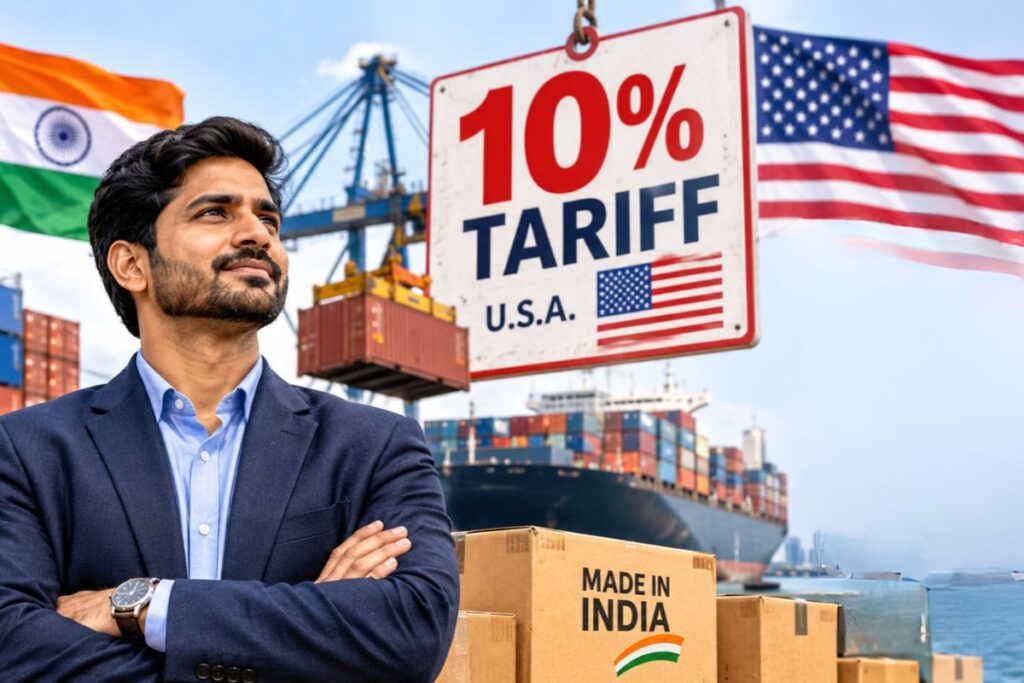
Mid-sized Indian exporters in garment, footwear, and seafood clusters are absorbing forced price cuts from American buyers to cover Washington’s 10% July 2026 tariff surcharge, while European buyers refuse to lower contract prices until the India-EU trade deal takes effect in 2027. To survive, suppliers in Tiruppur, Agra, and Visakhapatnam are shifting production lines toward the active India–United Kingdom trade agreement.
What Margin Squeeze Are Mid-Sized Indian Exporters Facing in 2026?
Mid-sized Indian exporters in labor-intensive sectors face an immediate 10% United States tariff surcharge stacked onto existing import duties, with zero offsetting relief from Europe until 2027. While national trade bodies point to India’s push toward $1 trillion in annual exports and celebrate New Delhi’s placement in the 10% tier of Washington’s July 2026 Section 301 tariffs, a trade penalty levied over forced-labor compliance rules, commercial accounts in Tiruppur, Agra, and Visakhapatnam tell a narrower story.
Since July 24, 2026, shipments entering the United States under Office of the United States Trade Representative (USTR) tariff heading 9903.05.44 carry an extra 10% duty, per USTR Federal Register Notice 91 FR 47318. That surcharge stacks directly onto existing most-favored-nation (MFN) tariffs, standard World Trade Organization import taxes applied to all trading partners, which run from 16.5% to 32% on cotton and synthetic apparel, alongside existing anti-dumping and countervailing duties on frozen shrimp.
Unlike pharmaceuticals, smartphones, and steel covered under separate exemptions, labor-intensive consumer goods fall inside the 55% of Indian exports to the United States subject to the full 10% penalty, according to a customs compliance breakdown of heading 9903.05.44. Meanwhile, the India–European Union Free Trade Agreement (FTA), a bilateral pact eliminating customs duties across most traded goods, concluded in January 2026, offers zero immediate tariff relief on 2026 invoices because legal ratification will not finish until 2027.
How Are US Buyers Clawing Back the 10% Section 301 Tariff at the Factory Gate?
American retail and foodservice importers are pushing the 10% Section 301 tariff back onto Indian manufacturers through demanded price discounts, trimmed commitments, and delayed shipment schedules.
According to industry accounts from Tiruppur reported by ETTextile, American customers responded to consecutive U.S. tariff escalations by holding back fresh orders and asking knitwear suppliers for price cuts of 10% to 20% to share the duty burden. National readymade garment shipment data compiled by the Apparel Export Promotion Council (AEPC) shows total Indian apparel exports fell 9.1% between April and August FY 2026–27, dropping from $6,765.6 million in the same period a year earlier to $6,149.7 million.
A second regulatory change hit product-development budgets before the Section 301 tariff took effect. Following the suspension of the $800 de minimis threshold, a rule that previously allowed low-value parcels to enter the United States free of customs duties and formal entry paperwork, U.S. Customs and Border Protection (CBP) began requiring formal or informal border entries and Section 301 duty payments on commercial parcels valued over $250, per a November 2026 customs analysis by Platton and an India-to-USA parcel duty guide by AICS.
For mid-sized garment and footwear suppliers, losing automatic de minimis clearance added merchandise processing fees of $34.58 to $670.86 per formal entry alongside tariff charges whenever small-batch sample shipments sent to American design offices are not permanently mutilated or entered under specialized prototype bonds.
Why Won’t European Contracts Reprice Under the India-EU Trade Deal Before 2027?
European buyers refuse to build zero-duty discounts into 2026 purchase orders because India-EU trade deal tariff cuts do not take legal effect until ratification is complete in 2027. With American margins compressed, many suppliers looked to Europe after Brussels and New Delhi concluded negotiations on January 27, 2026, yet European importers still pay standard MFN duties, up to 17% on footwear and 12% on apparel, in the meantime.
Under the European Commission’s September 11, 2026 ratification roadmap and industry trade briefings, formal signature is targeted for December 2026, pushing actual duty elimination into early-to-mid 2027. As Apollo Fashion International noted in its October 2026 leather sourcing analysis, European brands have held off on contract repricing until those tariff cuts become law.
At the same time, European buyers are front-loading regulatory compliance demands for 2027 order allocations:
- Footwear and leather: At a June 2026 Agra FTA readiness session organized with the Agra Footwear Manufacturers and Exporters Chamber (AFMEC) and the Development Council for Footwear and Leather Industry, compliance auditors warned cluster manufacturers that European buyers now require upfront Digital Product Passports, chemical traceability, and Ecodesign documentation before locking in post-ratification contracts.
- Marine products: While Visakhapatnam and Kakinada seafood processors saw a 22% week-on-week rebound in North American supermarket orders in August 2026 after the U.S. Department of Commerce lowered final countervailing duties, import taxes meant to offset foreign government subsidies, on Indian shrimp to 2.84% (down from a 4.72% preliminary estimate), per AquaSangham’s trade determination report, processors shipping to the European Union, India’s third-largest seafood market at 135,599 metric tons in FY 2025–26, per Marine Products Export Development Authority (MPEDA) figures, still face reinforced EU pesticide and antibiotic border inspections that tariff cuts do not waive.
Why Doesn’t India’s 10% US Tariff Rate Give Factories an Edge Over Rivals?
India’s 10% Section 301 rate gives labor-intensive factories no tariff edge because direct apparel and footwear competitors, including Bangladesh, Cambodia, and Indonesia, sit in the same 10% tier. Tracking five months of rapid U.S. tariff shifts in 2026 shows how that parity formed:
- February 20, 2026: The U.S. Supreme Court struck down earlier tariffs imposed under the International Emergency Economic Powers Act (IEEPA), removing punitive reciprocal and Russian-oil duties on Indian goods.
- February 24, 2026: Washington replaced those levies with a temporary 10% global surcharge under Section 122 of the Trade Act, keeping effective import taxes elevated through July 24.
- July 24, 2026: USTR replaced the expiring surcharge with a durable 10% Section 301 tariff under Federal Register Notice 91 FR 47318.
In its July 25, 2026 statement (PIB PRID 2289348), the Ministry of Commerce and Industry described India’s 10% rate, reduced from a 12.5% rate proposed on June 2, 2026, as a relative advantage over rival economies placed in the higher tier, noting that 45% of Indian exports to the United States remain exempt.
Yet USTR’s July 23 notice placed India’s direct labor-intensive competitors into the same 10% bracket. Nor has Washington operationalized the textile-specific tariff-rate quota, a volume cap allowing limited duty-free or reduced-duty imports, referenced in the July 25 Commerce Ministry release, leaving Tiruppur mills without preferential U.S. market access.
How Are Cluster Exporters Re-Routing Orders and Cash Flow to Survive?
Mid-sized manufacturers are surviving the U.S.–EU squeeze by redirecting factory capacity toward the India–UK Comprehensive Economic and Trade Agreement (CETA), a bilateral free trade pact that entered into force on July 15, 2026.
Taking effect nine days before Washington’s 10% Section 301 surcharge began, the pact eliminated British tariffs on 99% of Indian goods, including footwear (previously taxed up to 16%), apparel, and frozen seafood, per the Ministry of Commerce and Industry’s launch notification.
Early trade data shows exporters actively using that corridor:
- According to August 2026 bilateral trade figures analyzed by Economic Diplomacy, Indian exports to the United Kingdom rose 10.35% year-on-year to $1.26 billion in the first full month after CETA took effect, lifting total bilateral trade by 15.08%.
- Over the first two months of CETA implementation, Indian merchandise shipments to the United Kingdom climbed 8% even as British imports into India fell 17%, per Commerce Ministry data reported by Hindustan Times.
- Industry estimates compiled by leather trade portal APLF project duty-free British access will add $1 billion to $1.5 billion in Indian leather and footwear exports over the next three years, building on an FY 2025–26 base of $419.67 million.
To ease cash-flow strain while factories shift order books, the government extended key export tax-rebate schemes, including the Remission of Duties and Taxes on Exported Products (RoDTEP) through December 31, 2026, alongside the Rebate of State and Central Taxes and Levies (RoSCTL) for apparel, while easing registration rules for smaller consignments under ₹3 lakh, per AEPC regulatory circulars.
How quickly remaining cluster factories can re-route order books to active trade partners like the United Kingdom, while funding upfront European compliance audits, will decide how many mid-sized suppliers survive intact until European tariff cuts arrive in 2027.
Frequently Asked Questions
How much is the US tariff on Indian garments, footwear, and seafood in 2026?
Since July 24, 2026, non-exempt Indian goods entering the United States carry an additional 10% Section 301 surcharge under USTR heading 9903.05.44. That 10% duty stacks onto standard most-favored-nation tariffs, which run from 16.5% to 32% on cotton and synthetic apparel, plus a 2.84% final countervailing duty on frozen Indian shrimp.
Why are US buyers asking Indian exporters for price cuts?
According to Tiruppur industry reports, American importers responded to the July 2026 10% Section 301 tariff by holding back fresh orders and asking Indian knitwear suppliers for 10% to 20% price discounts to share the import duty. Additionally, the suspension of the $800 de minimis threshold added $34.58 to $670.86 in formal customs processing fees plus Section 301 duties onto commercial sample parcels valued over $250.
When will the India-EU trade deal lower tariffs for Indian exporters?
Tariff reductions under the India–European Union Free Trade Agreement are not expected to take effect until early-to-mid 2027. Although negotiations concluded on January 27, 2026, the European Commission’s September 11, 2026 ratification roadmap targets formal signature for December 2026, and European brands are withholding contract price adjustments until the cuts become law.
How are Indian exporters offsetting US tariff losses right now?
Mid-sized factories in apparel, leather, and seafood are shifting production lines toward the India–UK Comprehensive Economic and Trade Agreement (CETA), which took effect on July 15, 2026 and eliminated British duties on 99% of Indian goods. Indian exports to the United Kingdom rose 10.35% year-on-year to $1.26 billion in the first full month after implementation.