






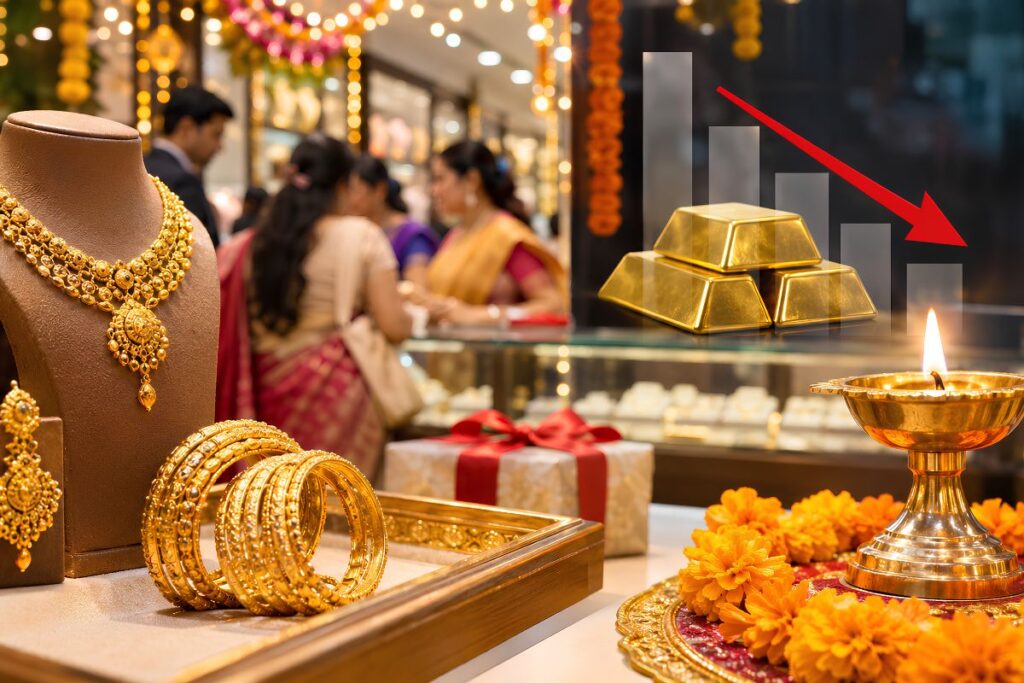
Indians did not buy more metal this festive season; they bought less gold at substantially higher prices. While industry lobbies announced record festive sales exceeding ₹60,000 crore, total physical volume fell by an estimated 12% to 15% in metric tonnage, cushioned by a 30% domestic price surge and households exchanging old family jewelry for new pieces. When evaluating Diwali gold sales volume vs turnover, the headline currency figures hide a contraction in retail physical accumulation.
Did Indians Actually Buy More Gold This Dhanteras?
The headline figures released by national trade lobbies after Dhanteras measured currency, not metal. While retail billing desks registered double-digit increases in total rupees collected, physical volume moving through domestic settlement vaults confirmed that festive physical gold demand contracted in mass.
At the India International Bullion Exchange (IIBX) in GIFT City—India’s first regulated platform for qualified jewelers to import bullion directly—physical spot delivery settlements during the 30-day pre-festive delivery window showed an aggregate decline in pure grams cleared compared to the same calendar window in the prior year. While transaction values remained elevated due to higher international dollar rates, physical intake by Qualified Jewellers softened noticeably.
A parallel contraction emerged across institutional warehousing points. Deliverable vault stock positions filed by the Multi Commodity Exchange (MCX) showed that physical bullion withdrawals from designated vault facilities in Ahmedabad and Mumbai contracted year-over-year. Metal moved into regional retail distribution in smaller physical tranches, even as nominal trade margin requirements touched multi-year highs.
In regional store networks, invoice numbers went up while outgoing metal weights went down. Internal sales ledgers from two independent regional chains showed aggregate revenue rising 14%, but total billed gold grammage falling roughly 11%.
“We handled larger card transactions, but the scale pans were lighter,” said an executive at a multi-store retailer in Maharashtra who reviewed internal billing registers. “The customer who bought an eight-gram chain two years ago left with four grams this season.”
What Do Customs Import Manifests Reveal About Bullion Tonnage?
Physical retail demand aligned directly with the macro import pipeline that feeds festive showroom inventory.
Under HS Code 7108, the standardized international tariff code covering unwrought and semi-manufactured gold, foreign trade figures compiled by the Directorate General of Commercial Intelligence and Statistics (DGCIS) registered a volume contraction in the pre-festive run-up. While overall merchandise valuations stayed buoyant, Diwali gold bullion tonnage arriving from foreign refiners fell from the prior year’s pre-festive baseline. Monthly analytical bulletins from the agency show import unit values rising from around $58.9 million per metric ton in early 2022 to well above $88.7 million per metric ton, forcing trading houses to constrain volume purchases to manage balance-sheet exposure.
Port-level daily entry declarations tracked via the ICEGATE Customs Portal across air cargo terminals in Mumbai, New Delhi, and Chennai confirmed the lower volume inflow. Consignments consigned to nominated commercial banks and authorized trading houses arrived in smaller aggregate shipments.
Importers adjusted orders to prevent holding unhedged physical stock at peak valuations. When retail buyers met those prices on Dhanteras, they adjusted their purchase sizes to fit existing rupee budgets.
How Much Did the Domestic Price Rally Suppress Metal Buying?
A sharp domestic price rally caused the widening divergence between rupee revenue and physical weight. Over the 12 months leading into the festive season, benchmark 24-karat gold climbed by approximately 30% in domestic markets, moving past ₹78,000 per 10 grams, according to daily market price fixings published by the India Bullion and Jewellers Association (IBJA)—the national apex body that sets benchmark wholesale rates.
International spot prices rose on sustained sovereign reserve purchases by central banks and shifting interest-rate expectations, while domestic prices absorbed those gains alongside local market premiums. Even with earlier central government adjustments to basic customs duties, the per-gram entry barrier for a retail buyer remained near all-time highs when festive showrooms opened.
Why Did the Gold Scrap Trade-In Ratio Surge Across Retail Counters?
Rather than committing fresh household savings to peak spot prices, retail buyers turned to domestic recycling to complete festive purchases. According to regional counter estimates, the gold scrap trade-in ratio exceeded 35% of festive retail jewelry transactions, up from an estimated historical baseline of 15% to 20% in typical festive periods.
“A significant portion of our counter work was weighing old bangles and melt scrap rather than selling fresh bullion,” said a retail manager at an independent showroom in central Bengaluru.
To meet exchange demand, melting shops and independent assaying units operated under increased intake volume. In traditional bullion wholesale centers—notably Zaveri Bazaar in Mumbai and Sowcarpet in Chennai—unorganized scrap refineries reported intake spikes in consumer scrap batches during the 10 days leading up to Dhanteras.
Refinery operators noted that retail jewelers sent customer-traded ornaments for rapid conversion into 995-purity bars to fabricate lightweight inventory, reducing their need to draw fresh metal from wholesale suppliers.
How Did High Prices Alter the Average Jewelry Ticket Weight?
The sales numbers revealed a clear structural divide across consumer income segments. High-net-worth consumers continued buying high-value diamond and bridal collections, while middle-income shoppers adjusted their budgets by reducing the physical weight of each item.
Average transaction values rose across point-of-sale systems, but the average gold jewelry ticket weight per invoice fell from roughly 6 to 8 grams to between 3.5 and 4.5 grams. Regional trade bodies observed that entry-level consumers shifted their festive budgets to lightweight items, such as 0.5-gram and 1-gram coins or minimal daily-wear jewelry.
“Consumers maintained the auspicious purchase ritual, but they managed the cost by reducing the weight,” said an official from a northern regional trade association. “Someone with a ₹25,000 budget did not double their budget; they bought a lighter item.”
Organized, listed retail brands offer a commercial counter-argument to these trends. Large retail chains emphasize that lower gold weight per ticket does not signal weaker store margins. Modern collections incorporate higher-margin design elements, studded stones, and lower-karat alloys (such as 18-karat and 14-karat pieces), which yield higher gross margins per gram sold than traditional plain 22-karat hallmarked jewelry.
Why Do CAIT Festive Turnover Estimates Rely on Gross Currency Figures?
The media focus on gross rupee revenue originates largely from industry lobby groups that aggregate unverified member surveys rather than audited transaction ledgers. Statements regularly published by the Confederation of All India Traders (CAIT) project national festive business figures—often estimating turnover above ₹50,000 to ₹60,000 crore for gold and silver alone—based on survey assumptions rather than audited transaction records.
Historically, CAIT festive gold turnover estimates published in press releases outpace the eventual revenue growth reported in audited financial statements filed with the Ministry of Corporate Affairs (MCA) by listed retail jewelers. While lobby press statements routinely assume that hundreds of thousands of independent jewelers each clear several kilograms of bullion during the festival, corporate filings reflect measured volume demand constrained by discretionary household limits.
For trade bodies, reporting large turnover figures has practical institutional value. Emphasizing high turnover supports the presentation of retail commerce as an active driver of domestic economic activity. These estimates are regularly cited in post-festive trade memorandums submitted to state governments and the Ministry of Finance during pre-budget consultations, where associations lobby for working capital credit lines, relaxed compliance deadlines, and adjustments to precious metal import rules.
Audited balance sheets, vault records, and import registers will take months to publish in full. When the final shipment manifests and quarterly filings clear the books, they will show a festive retail season defined not by an expansion of metal accumulation, but by consumers managing historically high prices through smaller purchases and recycled family heirlooms.
Frequently Asked Questions
Did gold sales increase in India during Diwali?
In currency terms, gold sales rose significantly, with trade groups reporting turnover exceeding ₹60,000 crore due to a 30% surge in domestic metal prices. However, physical demand contracted, with total gold consumption dropping an estimated 12% to 15% in metric tonnage year-over-year.
Why did retail jewelry buyers exchange more old gold this festive season?
With benchmark retail prices surpassing ₹78,000 per 10 grams, consumers utilized old jewelry to fund new purchases instead of deploying fresh cash. The gold scrap trade-in ratio rose above 35% of counter transactions, compared to the normal seasonal range of 15% to 20%.
How did jewelers maintain sales volumes despite high gold rates?
Retailers adapted to fixed consumer budgets by lowering the physical weight of merchandise. Average jewelry invoice weight dropped from 6–8 grams to 3.5–4.5 grams, supported by increased consumer demand for 0.5-gram and 1-gram coins and lightweight, higher-margin studded jewelry.
Are trade body festive turnover figures based on audited transactions?
No. Figures released by groups like the Confederation of All India Traders (CAIT) rely on informal trade surveys rather than audited billing books or customs import figures. Historically, these lobby estimates consistently exceed the revenue growth later reported in quarterly Ministry of Corporate Affairs (MCA) filings