






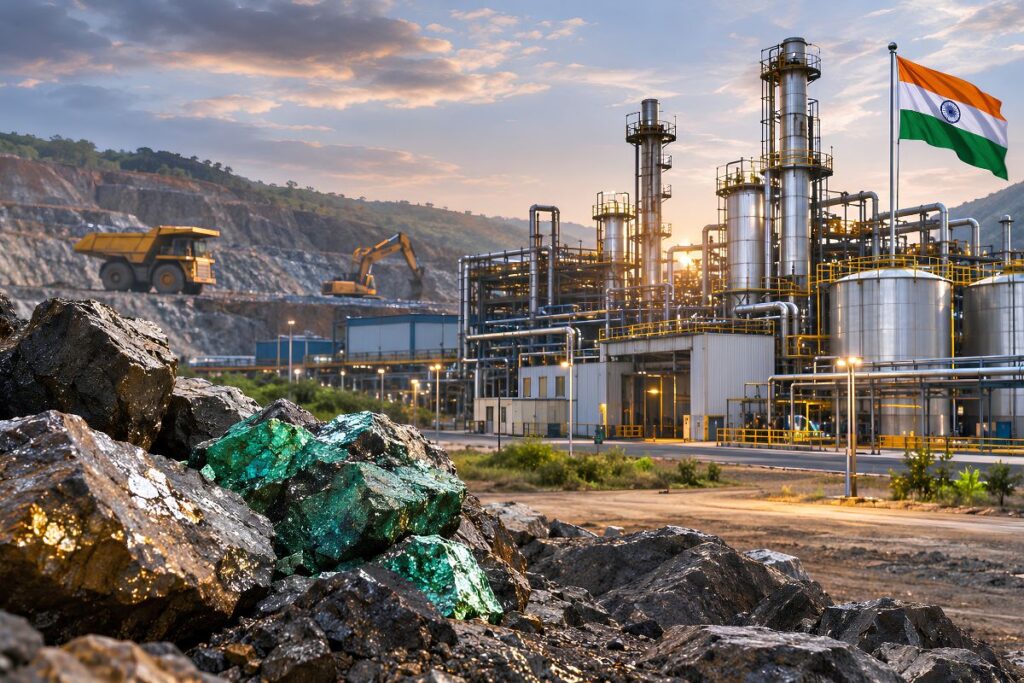
Planning for critical mineral refinery siting in India centers on coastal industrial zones in Gujarat, Tamil Nadu, and Odisha to process imported ores. However, statutory environmental reviews, tight water allocations, and an absence of hazardous waste landfills will delay plant commissioning by three to five years, pushing operational output past the central government’s 2030 target.
Where Will India Actually Build Its Critical Mineral Processing Hubs?
Critical mineral refinery siting in India must prioritize coastal industrial hubs near deep-water ports because domestic facilities rely entirely on imported raw concentrates. Converting raw lithium spodumene or nickel concentrate into battery chemicals is chemical metallurgy rather than standard manufacturing. Plants depend on hydrometallurgy—a chemical extraction technique that dissolves mineral ores in concentrated acid solutions to separate and crystallize pure battery salts.
This extraction route demands three physical site criteria: contiguous industrial land parcels approved for chemical operations, high-volume industrial water allocations, and access to secure hazardous waste landfill capacity.
Current state industrial corridors fail to meet these requirements. Under the Central Pollution Control Board industrial classification guidelines, hydrometallurgical mineral processing is categorized as a “Red Category” industry, denoting operations with the highest pollution potential.
Water access creates an immediate physical constraint. Producing one tonne of refined battery chemical consumes between 15 and 30 cubic meters of fresh or desalinated water. A standard 20,000-tonne facility therefore requires up to 600,000 cubic meters of water each year.
State development agencies, including the Gujarat Industrial Development Corporation (GIDC) and the State Industries Promotion Corporation of Tamil Nadu (SIPCOT), manage industrial estates where existing water quotas are already committed to operating petrochemical and textile facilities.
No state industrial agency currently maintains a designated industrial park that pairs these high water allocations with approved landfill permits for leached chemical residues.
Why Do State Environmental Clearances Take Over 1,200 Days?
Statutory review for heavy chemical metallurgical units takes a median of 41 months, roughly 1,200 days, to progress from initial filing to an operational permit, making commercial production by 2030 legally unviable. Under the Environmental Impact Assessment Notification, mineral conversion facilities are designated as Category A projects requiring central environmental clearance from the Ministry of Environment, Forest and Climate Change (MoEFCC), followed by a Consent to Establish (CTE) order from the relevant State Pollution Control Board (SPCB).
Data from the MoEFCC PARIVESH environmental clearance portal shows that Category A metallurgical projects cleared between 2020 and 2025 faced this extended timeline due to strict procedural rules.
The statutory review requires sequential steps: collecting baseline environmental data across three non-monsoon months, preparing the detailed Environmental Impact Assessment, conducting mandatory district public hearings, completing Expert Appraisal Committee reviews, and securing state board site permits.
For processing projects that had not initiated baseline environmental surveys before 2026, the 1,200-day statutory timeline rules out commercial operation by 2030 under current environmental regulations.
What Did the Central Government’s ₹2,800-Crore Scheme Promise?
The central government designed its ₹2,800-crore capital expenditure incentive under the National Critical Minerals Mission policy blueprint to eliminate domestic supply risks by subsidizing factory equipment. Official trade assessments in the Ministry of Mines Report on Critical Minerals for India confirm that the country imports 100% of its unrefined and refined lithium, cobalt, and nickel salts.
The policy intends to finance domestic processing infrastructure to supply 50 gigawatt-hours of advanced chemistry cell battery plants scheduled under central production incentives by 2030.
Cabinet planning notes treat upfront state cash grants as the primary catalyst to mobilize private investment. However, the policy treats physical refinery siting as an operational task for commercial bidders, underestimating the procedural friction embedded in decentralized state environmental administration.
Why Do Port Locations Trigger Coastal Regulation Zone Flashpoints?
Because India has no commercial lithium or nickel mines, refineries must sit within 50 kilometers of cargo ports like Dahej or Mundra in Gujarat, Tuticorin in Tamil Nadu, or Gopalpur in Odisha to process imported mineral feeds. This coastal proximity places conversion plants directly under the regulatory scope of the MoEFCC Coastal Regulation Zone (CRZ) Notifications, which restrict industrial activity near the shoreline.
Hard-rock mineral leaching generates acidic, high-salinity wastewater streams. State Coastal Zone Management Authorities enforce environmental protection mandates that prohibit the discharge of industrial effluent into marine or intertidal environments governed by CRZ-I and CRZ-III rules.
To meet marine protection standards, state regulators require refiners to build Zero Liquid Discharge (ZLD) installations, which treat industrial wastewater by recovering purified water through continuous evaporation and leaving behind solid dry salt residues.
Operating mechanical vapor recompression systems inside a ZLD setup requires constant electricity and steam. Running these systems adds between 18% and 22% to a hydrometallurgical plant’s ongoing operational expenses, eroding cost competitiveness against foreign refiners that discharge treated wastewater into open marine outfalls.
Where Will Refineries Store Millions of Tonnes of Toxic Tailings?
Hydrometallurgical extraction generates substantial toxic solid waste, producing between 6 and 9 tonnes of hazardous aluminosilicate residue, neutralized iron-aluminum cakes, and sodium sulfate salts for every single tonne of battery-grade lithium hydroxide output. A 20,000-tonne conversion refinery generates up to 180,000 tonnes of hazardous solid tailings annually, all of which require long-term storage in engineered, impermeable containment cells to protect agricultural aquifers.
Industrial waste audits published by the Central Pollution Control Board show that operational Treatment, Storage, and Disposal Facilities (TSDFs) across key maritime industrial corridors have limited remaining volumetric capacity.
When private developers attempt to acquire agricultural land to build private hazardous waste containment facilities, they encounter organized property disputes. Public consultation records across industrial coastal districts show persistent objections from farming communities over groundwater salinity and chemical seepage risks.
Litigation surrounding land acquisition, district objections, and state High Court challenges routinely adds two to four years to project development schedules.
Can Dedicated Industrial Parks Accelerate Plant Construction?
Rival processing nations bypass localized regulatory deadlocks by developing pre-cleared industrial megasites. In Western Australia, state authorities established designated chemical estates through the DevelopmentWA Strategic Industrial Areas framework at Kwinana and Kemerton. State agencies completed upfront environmental impact studies, installed heavy utility hookups, and cleared land titles before auctioning parcels to private chemical refiners.
India instead requires private chemical developers to secure land titles, negotiate municipal water allocations, and conduct environmental public hearings independently across different state boards.
Officials in the Ministry of Mines state that the central administration plans to designate proposed “Critical Mineral Processing Parks” as Projects of National Importance, aiming to coordinate single-window environmental approvals with state secretariats to shorten licensing periods.
State pollution control board officials maintain that environmental review periods cannot be shortened. Hydrometallurgical plants handle large volumes of concentrated sulfuric acid and caustic soda under high temperatures and pressure. Regulators contend that compressing review periods or easing zero-liquid-discharge mandates creates severe risks of soil acidification and groundwater contamination.
Until state governments deliver pre-cleared industrial land equipped with dedicated water lines and secure waste containment sites, capital grants alone cannot accelerate production. India’s planned processing plants will remain tied up in state regulatory reviews, keeping domestic battery producers dependent on imported chemical salts past 2030.
Frequently Asked Questions
Where will critical mineral refineries be located in India?
Refineries will be concentrated within 50 kilometers of major deep-water ports in Gujarat, Tamil Nadu, and Odisha to process imported mineral feeds, including Australian spodumene and Southeast Asian nickel. These coastal sites provide marine logistics access but face strict Coastal Regulation Zone environmental limits on water discharge.
Why will environmental clearances delay Indian mineral refineries past 2030?
Hydrometallurgical mineral processing facilities are classified as Category A industrial projects, requiring central Ministry of Environment clearances and state-level Consent to Establish orders. Historical regulatory data from the PARIVESH portal reveals that completing baseline environmental surveys, public consultations, and committee reviews takes a median of 41 months (roughly 1,200 days).
What happens to the hazardous chemical waste produced by lithium refining?
Processing hard-rock spodumene ore into battery-grade lithium hydroxide generates 6 to 9 tonnes of hazardous aluminosilicate residue and high-sulfate chemical filter cake for every single tonne of finished product. This waste must be entombed in lined, engineered Treatment, Storage, and Disposal Facilities (TSDFs), which are currently facing severe volumetric shortages across industrial states.
Why does Zero Liquid Discharge make Indian lithium refining more expensive?
Coastal environmental regulations prohibit discharging high-salinity industrial wastewater into coastal marine waters, requiring refiners to operate Zero Liquid Discharge (ZLD) plants. Running these thermal evaporation and salt crystallization systems increases ongoing plant operating expenses by 18% to 22%.