






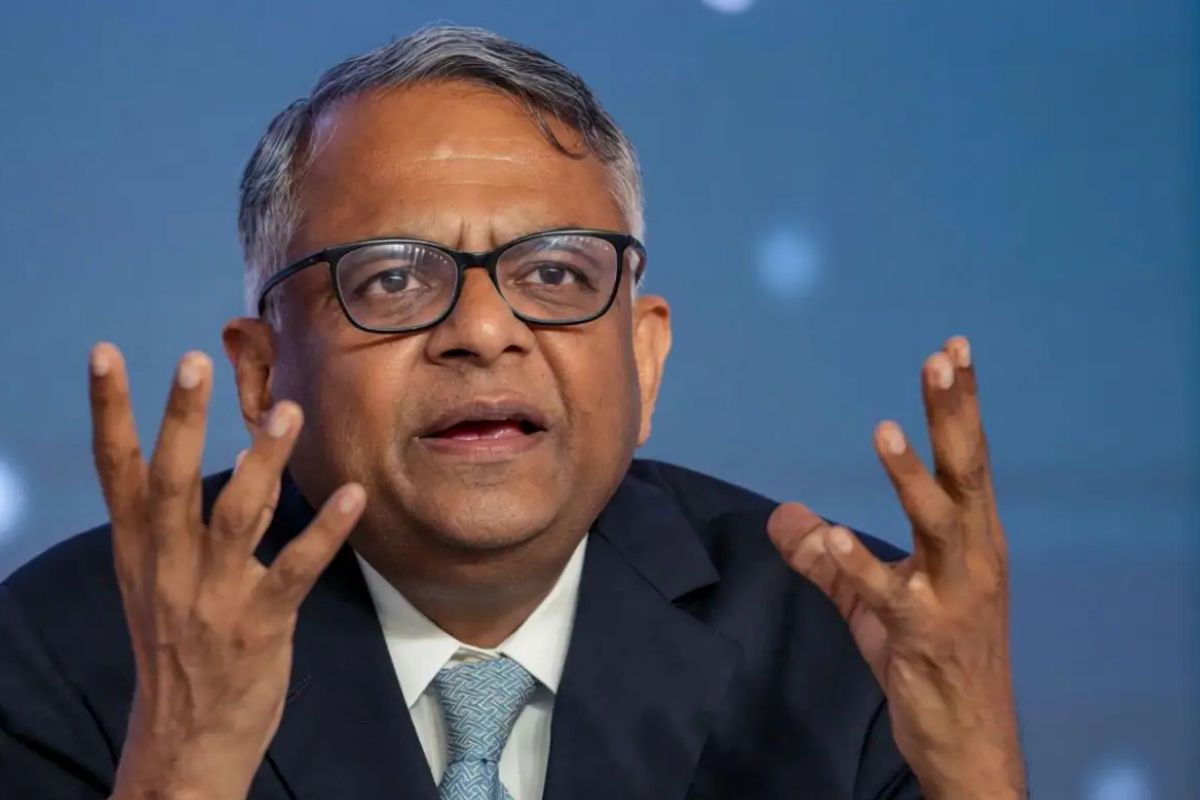
Tata Sons generates its profit almost entirely from Tata Consultancy Services dividends, which accounted for over 80% of the holding company’s total dividend receipts in FY26. This single IT subsidiary provided ₹28,291 crore, effectively funding the group’s standalone profit surge and Chairman N Chandrasekaran’s ₹158.7 crore payout.
How Does Tata Sons’ Profit Depend on the TCS Dividend?
Tata Sons relies on Tata Consultancy Services Limited (TCS), the group’s IT services export subsidiary, to generate more than four-fifths of its holding company income.
Mainstream coverage of Tata Sons Chairman Natarajan Chandrasekaran’s FY26 pay hike focused on top-line performance: group revenue reached ₹16.24 lakh crore, net profit rose to ₹170,525 crore, and holding company profits reached ₹32,000 crore.
Behind those consolidated numbers sits a stark balance sheet reality.
In FY26, according to company regulatory disclosures reported by India Today, Tata Sons received ₹28,291 crore in dividend income directly from its 72.3% equity stake in TCS. This single stream accounted for over 80% of total dividend inflows into the holding company, a core investment company that acts as the principal investment holding firm for the Tata Group and provides the primary cash cushion for its ₹32,000 crore standalone profit.
Tata Sons Standalone Inflow Breakdown (FY26)
——————————————————
TCS Dividend Inflow: 80%+ (₹28,291 crore)
All Other Subsidiaries: <20% (~₹4,000–₹5,000 crore)
Target Holding Net Profit: ₹32,000 crore
Out of this TCS-derived treasury, Chandrasekaran received ₹158.66 crore: a fixed component of ₹17.97 crore (up 18.8% from ₹15.12 crore) and a profit-linked commission of ₹140.69 crore.
While public narratives attribute these rewards to modern capital deployments, such as semiconductors, aviation turnarounds, and battery gigafactories, the balance sheet shows that legacy IT software exports underwrite the chairman’s compensation.
How Has Tata Sons Dividend Income from TCS Evolved Over 5 Years?
Tata Sons dividend income from TCS has consistently accounted for 80% to 84% of all dividend inflows to the parent company between FY22 and FY26.
Across the five-year stretch during which Chandrasekaran earned a cumulative ₹671 crore as Tata Sons chairman in commission and base pay, TCS consistently generated the vast majority of Tata Sons’ actionable cash.
- FY22: TCS declared total payouts yielding ~₹19,000 crore to Tata Sons, representing 83% of holding company dividend receipts.
- FY23: TCS payouts delivered ~₹21,000 crore to Tata Sons, representing 81% of holding company dividend receipts.
- FY24: TCS payouts delivered ~₹23,500 crore to Tata Sons, representing 84% of holding company dividend receipts.
- FY25: TCS payouts delivered a record ₹32,184 crore to Tata Sons, as reported by The CSR Journal, representing over 82% of holding company dividend receipts.
- FY26: TCS payouts delivered ₹28,291 crore to Tata Sons, representing over 80% of total holding company dividend receipts.
By contrast, non-IT subsidiaries contributed far smaller cash returns to the parent holding entity.
Tata Steel Limited and Tata Motors Limited provided fluctuating cyclical dividends, while consumer anchors like Titan Company Limited contributed steady but modest cash relative to their enterprise valuations. Growth units like Air India Limited, Tata Electronics Private Limited, and Agratas Energy Storage Solutions Limited yielded zero dividends to the holding entity, drawing down capital instead of contributing to standalone income.
Group’s strategy for capital allocationllocation Strategy Fund New Ventures?
The Tata Group capital allocation strategy uses dividend flows from cash-generative mature companies to fund equity infusions into capital-intensive greenfield industrial projects.
Over the past four years, public commentary around the group focused heavily on high-profile expansion into capital-intensive industries. The group committed billions of dollars to build a semiconductor assembly and fabrication facility under Tata Electronics in Dholera, Gujarat, construct an Agratas EV battery gigafactory, and absorb operating losses while integrating Air India and Vistara into a single airline enterprise.
These new ventures require immediate, heavy equity injections.
Because greenfield industrial projects operate at a loss or low margin during buildout phases, they generate no dividend income for Tata Sons. The holding company funds these capital commitments by drawing down on dividends supplied by its established businesses.
In practice, cash flows generated by TCS software engineers directly support the steel, silicon, and aviation capital deployments of the broader group.
How Is N Chandrasekaran’s Salary and Commission Calculated?
N Chandrasekaran’s salary and performance commission are tied directly to Tata Sons’ standalone net income, which is dominated by holding-level dividend receipts rather than consolidated operational performance across subsidiaries.
Under Section 197 of the Companies Act, 2013, executive commission is capped as a percentage of standalone net profit. Tata Sons’ Nomination and Remuneration Committee (NRC), the board panel that sets executive pay, uses a formula that ties variable compensation directly to holding-level net income.
This structure creates a specific governance outcome.
Because standalone net income is composed primarily of dividend receipts rather than consolidated return on invested capital (ROIC), the variable commission reflects the cash output of legacy assets rather than the operational turnaround or gestation progress of new bets.
Tata Sons’ board views this structure as an appropriate mechanism for enterprise risk balancing. Holding company executives manage a multi-industry portfolio, using cash-generative mature companies to incubate strategic assets that require long gestation periods. Rewarding leaders based on standalone balance sheet strength reflects successful capital redistribution across the group.
Yet the math remains clear: the chairman’s commission tracks the profitability of a mature IT exporter rather than the operational performance of newly acquired or founded capital-guzzling units.
What Are the Financial Risks if TCS Dividend Growth Slows?
A slowdown in TCS dividend growth compresses Tata Sons’ holding company liquidity just as capital commitments for semiconductors, aviation, and battery factories reach peak execution phases.
As margin pressures and slower IT client spending cap TCS payout growth, dividend income to the parent entity compresses, evidenced by the 12% drop in TCS payouts in FY ’26. At the same time, capital commitments for the Dholera fab, Air India fleet upgrades, and gigafactory expansions reach peak execution funding.
According to a credit rating report published by CRISIL Ratings on Tata Projects Limited, Tata Sons provides key financial flexibility and capital infusions (such as fully subscribing to multi-thousand crore rights issues for operating units). CRISIL notes that while parent support and liquidity remain strong, Tata Sons relies on its unencumbered cash reserves and subsidiary dividend receipts to maintain these capital calls.
If TCS dividend growth slows while capital calls from infant subsidiaries increase, Tata Sons will face a choice: increase debt at the holding company level, slow down capex deployment in strategic bets, or liquidate minor stakes across listed holdings. Until those new industries reach profitability, the group’s holding profits, and its executive remuneration, remain tethered to a single software exporter.
Interconnected Corporate Finance and Conglomerate Capital Allocation
For in-depth forensic insights into conglomerate holding structures, subsidiary debt burdens, and enterprise balance sheet cleanups, examine our investigative briefings:
- Tata Consumer Acquisitions Profit: The Hidden Debt Burden and Leverage Profile, analyzing post-merger integration costs, goodwill amortisation, and balance sheet leverage within the group.
- The Currency Illusion: How Dollar Appreciation Masks Flat Volumes for Mid-Tier IT, unpacking constant-currency real revenue growth versus reported FX-driven top-line gains in Indian IT services.
- Why Did Air India’s FY26 Loss Hit ’22,238 Crore? Inside the Balance Sheet Cleanup, investigating holding company equity infusions, legacy fleet impairment, and turnaround capex.
- Subhash Chandra JC Flowers Settlement: Debt Restructuring & Equity Pledge Mechanics, dissecting structured settlement treaties, promoter encumbrance, and institutional recoveries.
Frequently Asked Questions
What was N Chandrasekaran’s salary in FY26?
Tata Sons Chairman N Chandrasekaran earned ₹158.66 crore in FY26, comprising ₹17.97 crore in fixed salary and perquisites along with a profit-linked commission of ₹140.69 crore.
How much dividend did TCS pay to Tata Sons in FY26?
TCS paid ₹28,291 crore in dividend income to Tata Sons in FY26 based on the holding company’s 72.3% equity stake, representing a 12% drop from the record ₹32,184 crore paid in FY25.
What percentage of Tata Sons’ profit comes from TCS?
Dividends from TCS consistently account for over 80% of Tata Sons’ total dividend receipts, providing the core cash flow underwriting its standalone net profit of ₹32,000 crore.
Why does N Chandrasekaran’s pay depend on TCS dividends?
Tata Sons’ Nomination and Remuneration Committee ties executive performance commission to standalone net profit under Section 197 of the Companies Act, 2013, a figure driven almost entirely by TCS dividend inflows rather than consolidated group operations.