






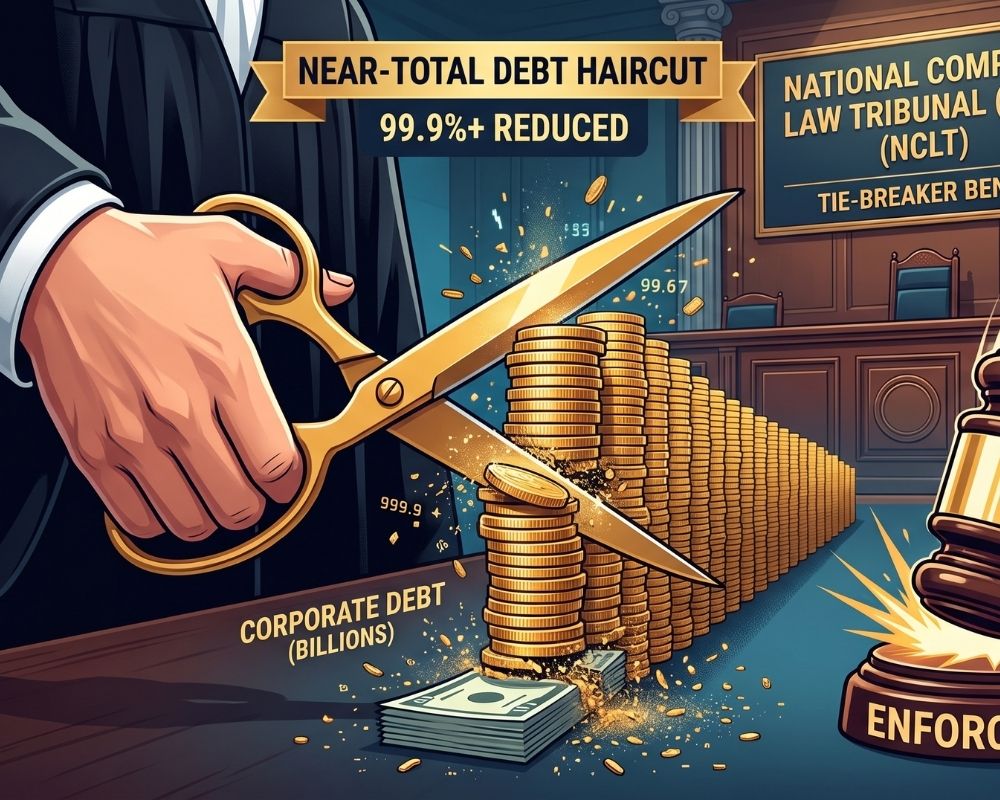
Executive Summary: Under India’s Insolvency and Bankruptcy Code (IBC) 2016, judicial splits between National Company Law Tribunal (NCLT) bench members increasingly result in third-member tie-breaker referrals that systematically ratify extreme debt haircuts. Grounded in the Supreme Court of India’s non-justiciable “commercial wisdom of the Committee of Creditors (CoC)” doctrine, these tie-breaker determinations prioritize resolution certainty and asset velocity over dissenting creditor recoveries. From corporate insolvency proceedings to high-profile personal guarantor insolvencies—such as the Essel Group/Subhash Chandra ₹6.25 crore settlement—the legal mechanism leaves minority and unsecured financial lenders absorbing haircut losses frequently exceeding 90%.
The Mechanism of the NCLT Third-Member Referral
When a two-member bench of the National Company Law Tribunal (NCLT)—comprising a Judicial Member and a Technical Member—delivers dissenting verdicts on an IBC resolution plan, Section 419(5) of the Companies Act 2013 mandates that the point of disagreement be referred to the President of the NCLT for allocation to a third judge.
Historically, dissenting technical members have frequently raised concerns regarding excessive haircut depth, undervaluation of underlying assets, or potential promoter backdoors under Section 29A. However, when referred to a tie-breaker, rulings overwhelmingly align with the judicial faction that enforces the voting threshold of the Committee of Creditors under Section 30(4), heavily influenced by jurisprudence established by the Supreme Court of India in landmark judgments like K. Sashidhar v. Indian Overseas Bank and the Essar Steel ruling.
This dynamic was central to our forensic breakdown of how Subhash Chandra’s ₹6.25 crore repayment plan passed and directly connects to broader credit risks analyzed in our study on India’s capex surge and cost-overrun debt refinancing.
Landmark Resolutions and Haircut Precedents
Data compiled by the Insolvency and Bankruptcy Board of India (IBBI) underscores that across resolved corporate insolvency resolution processes (CIRPs), financial creditors have absorbed average realized haircuts between 65% and 85%, climbing above 90% in distressed liquidations:
| Insolvency Case | Admitted Financial Claims | Approved Resolution Realization | Effective Haircut % | Judicial Principle Invoked |
|---|---|---|---|---|
| Dewan Housing (DHFL) | ₹87,082 Crore | ₹37,250 Crore | 57.2% | Commercial wisdom of CoC upheld over fixed-deposit holders |
| Videocon Industries | ₹64,838 Crore | ₹2,962 Crore | 95.4% | Group insolvency consolidation; NCLAT subsequently remitted |
| Reliance Infratel | ₹41,500 Crore | ₹3,720 Crore | 91.0% | Priority distribution to senior secured financial institutions |
| Subhash Chandra (Essel) | ₹1,100+ Crore Guarantees | ₹6.25 Crore Structured | 99.4% | Personal guarantor repayment plan majority threshold approval |
Why Minority and Dissenting Lenders Have Little Recourse
Under Section 30(2)(b) of the IBC, dissenting financial creditors are entitled only to the liquidation value of their secured interest. If the liquidation value is nominal, their payout drops to near zero, regardless of the face value of the underlying corporate loans.
Judicial precedent severely limits the NCLT’s scope of inquiry. Tribunals cannot review whether a business could fetch higher value under alternative restructuring structures or evaluate whether the CoC acted with fiscal prudence. For small vendors and unsecured creditors operating without institutional security, corporate insolvencies represent near-total capital write-offs, reflecting tribunal limitations similar to those outlined in our report on whether MSMEs can sue equipment vendors in commercial and consumer courts.
Frequently AskeBQuestions
What is an NCLT tie-breaker ruling?
An NCLT tie-breaker ruling occurs when the two-member bench (Judicial and Technical) reaches a split verdict. Under Section 419(5) of the Companies Act 2013, the matter is referred to a third judge appointed by the NCLT President, whose decision breaks the deadlock.
Can the NCLT reject a resolution plan because the haircut is too high?
No. The Supreme Court of India has repeatedly affirmed that the “commercial wisdom” of the Committee of Creditors (CoC) is non-justiciable. Unless an IBC resolution plan violates statutory eligibility provisions (such as Section 29A or Section 30(2)), the tribunal cannot reject it solely on the grounds of an excessive debt haircut.
What is the typical recovery rate under IBC CIRP proceedings?
According to IBBI regulatory data, financial creditors recover an average of 30% to 35% of admitted claims across successful CIRP cases, meaning typical cumulative debt haircuts range from 65% to 70%, with distressed or asset-light cases exceeding 90%.