






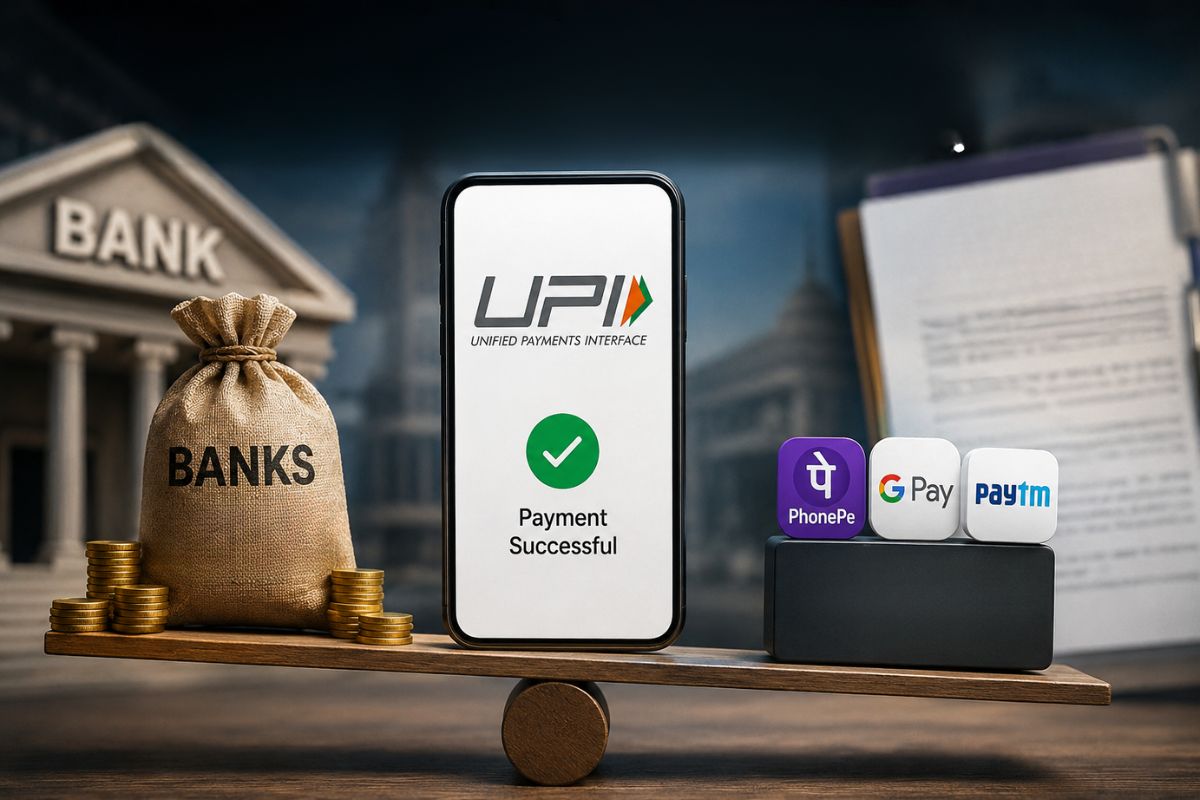
The parliamentary authorization enabling the government to permit banks to levy charges on UPI transactions has exposed a commercial rift between traditional lenders and non-bank payment platforms. According to internal National Payments Corporation of India (NPCI) steering committee draft proposals, the proposed Merchant Discount Rate (MDR) distribution model allocates between 60% and 70% of payment fees to issuing and acquiring banks. This leaves Third-Party Application Providers (TPAPs) like PhonePe and Google Pay with less than 20% of the revenue split, despite non-bank payment apps processing over 85% of consumer Unified Payments Interface (UPI) transaction volume and absorbing up to 80% of customer acquisition and fraud mitigation costs.
A Merchant Discount Rate (MDR) is a fee charged to merchants by payment processing entities for accepting digital payments from customers.
Who benefits financially from UPI transaction charges?
Issuing and acquiring banks stand to capture up to 70% of revenue if the Ministry of Finance reintroduces MDR on digital transactions.
Under the draft interchange distribution model under review by National Payments Corporation of India (NPCI) working groups, fee allocations prioritize account-hosting institutions:
| Stakeholder Entity | Role in Transaction | Proposed MDR Revenue Share | Operational Responsibilities |
| Issuing Banks (e.g., State Bank of India, HDFC Bank) | Maintains customer deposit ledger | 40% – 45% | Core Banking System (CBS) debit authorization, settlement liability |
| Acquiring Banks | Onboards merchant bank accounts | 20% – 25% | Merchant account settlement, terminal credit routing |
| TPAPs (PhonePe, Google Pay) | Front-end app interface | 15% – 20% | User acquisition, app UI/UX, preliminary fraud filtering, cloud routing |
| NPCI | Central switch infrastructure | 5% – 10% | National switch operations, dispute resolution protocols |
Third-Party Application Providers (TPAPs) are non-banking technology companies authorized by the Reserve Bank of India (RBI) to offer front-end payment software interfaces connected to bank accounts.
This proposed division creates a financial imbalance. While issuing banks maintain the ledger, TPAPs handle customer support, app performance, and dynamic security updates during peak traffic hours.
Why do PhonePe and Google Pay face higher costs than traditional banks?
Non-bank payment applications operate under structural cost asymmetries because they lack deposit-taking licenses and pay third-party vendors for every transaction processed.
According to financial disclosures filed with the Ministry of Corporate Affairs (MCA) by PhonePe India Private Limited and Google India Digital Services, TPAPs incur between ₹0.12 and ₹0.18 per transaction in direct technology expenses. These expenses include cloud infrastructure hosting, short message service (SMS) One-Time Password (OTP) verification fees, and proprietary machine-learning fraud detection systems.
[ CUSTOMER PAYMENT REQUEST ]
│
▼
┌─────────────────────────────┐
│ TPAP (PhonePe/Google Pay) │ ──► Absorbs: Cloud infra, SMS/OTP, Fraud ML
└──────────────┬──────────────┘ (Cost: ₹0.12 – ₹0.18 per transaction)
│
▼
┌─────────────────────────────┐
│ Issuing Bank (Core System) │ ──► Captures: Low-cost CASA deposits
└─────────────────────────────┘ (Yield: 3.5% – 4.0% net interest margin)
In contrast, issuing banks capture economic benefits that balance their system overhead. UPI activity retains liquidity inside Current Account Savings Account (CASA) balances. CASA balances are low-cost bank deposits that allow financial institutions to earn net interest margins of 3.5% to 4.0% by deploying those funds into credit markets. Banks earn money from the float created by UPI transactions, whereas non-bank payment apps generate zero deposit yield.
How does NPCI’s 30% market share cap compound TPAP losses?
The combination of a 15% MDR revenue share and National Payments Corporation of India’s 30% volume cap creates a regulatory conflict for non-bank apps.
The NPCI market share cap is a regulatory directive designed to limit any single non-bank TPAP from processing more than 30% of total UPI transaction volume over a trailing three-month period.
As recorded in monthly UPI transaction data, TPAPs rely on volume to cover fixed operational costs because they cannot cross-subsidize payment routing through deposit float. Restricting market share to 30% limits absolute transaction volume while capping fee share under the draft MDR model.
This policy combination prevents non-bank operators from reaching profitability on transaction routing alone. Consequently, tech platforms must either charge direct consumer convenience fees or slow down non-revenue feature updates.
What legal changes enabled the return of UPI MDR fee split rules?
The statutory foundation for levying fees was established when Parliament passed the Taxation and Other Laws (Amendment) Act, amending Section 10A of the Payment and Settlement Systems Act, 2007.
The Payment and Settlement Systems Act, 2007, is the federal law that grants the Reserve Bank of India regulatory authority over electronic payment networks in India.
The amendment repealed the statutory ban on charging fees for UPI and RuPay transactions, which was instituted in late 2019 under Section 269SU of the Income Tax Act, 1961.
As detailed in legal analyses of Section 10A, by removing this hard ban, Parliament transferred fee-setting authority to executive notifications issued by the Ministry of Finance and regulatory guidelines set by the Reserve Bank of India. This legislative shift bypassed dedicated parliamentary committee reviews on digital economy pricing.
How will fintech platforms pivot to survive bank-favoured UPI charges?
Faced with low returns from standard UPI transaction routing, major non-bank payment platforms are shifting capital investments away from basic payment infrastructure.
According to product disclosures and investor briefings from domestic fintech firms, payment operators are prioritizing high-margin financial services distribution, including:
- Credit on UPI: Monetizing pre-sanctioned bank credit lines and credit card links routed through QR handles.
- Mutual Fund and Insurance Distribution: Converting payment users into wealth management clients to collect distribution commissions.
- Proprietary Merchant Soundboxes: Charging fixed monthly hardware subscription fees to offline merchants rather than relying on variable transaction interchange.
This strategic reallocation of capital means non-bank platforms will treat standard UPI payment processing as a customer acquisition channel rather than a core profit source.
Frequently Asked Questions
Will consumers have to pay fees for making everyday UPI payments?
No consumer fees are taking effect immediately because executive notifications from the Ministry of Finance have not been issued. However, the legal amendment to Section 10A of the Payment and Settlement Systems Act, 2007 gives the government authority to permit banks and payment service providers to levy selective charges on high-value or merchant transactions in the future.
How much money do banks receive compared to PhonePe and Google Pay under draft UPI MDR proposals?
According to internal draft steering proposals from National Payments Corporation of India (NPCI), issuing and acquiring banks are set to receive between 60% and 70% of total MDR revenue. Third-Party Application Providers (TPAPs) like PhonePe and Google Pay are allocated between 15% and 20% of the fee pool.
Why are PhonePe and Google Pay hit harder by UPI fees than traditional banks?
PhonePe and Google Pay incur direct cloud hosting, SMS authentication, and fraud verification costs ranging between ₹0.12 and ₹0.18 per transaction without taking banking deposits. Traditional banks balance core system processing expenses using the interest yield earned on low-cost Current Account Savings Account (CASA) deposits retained through UPI transfers.