






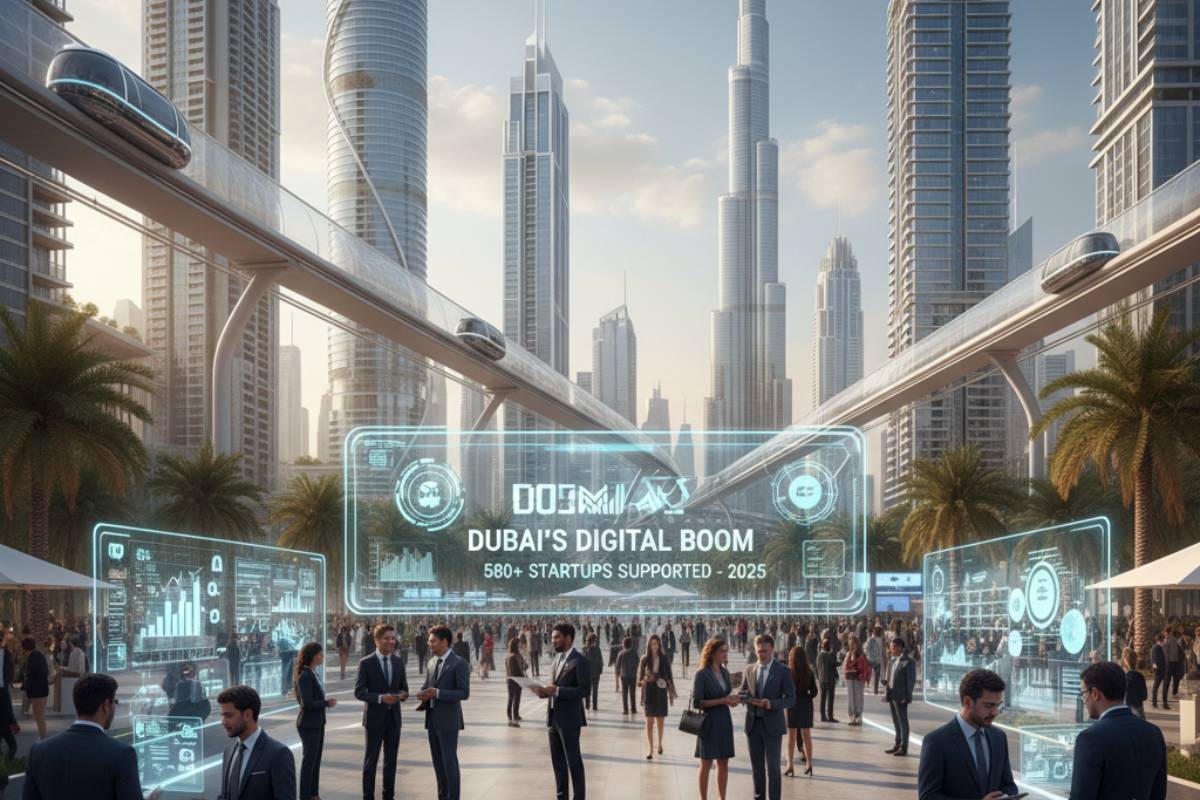
Dubai has supported 582 digital startup companies in the first nine months of 2025. This is a big step toward its goal of becoming a global center for technology and innovation.
This rise isn’t just a number; it shows how the emirate is becoming more important in the digital economy, how it attracts international entrepreneurs, and how it is making a bigger push to keep up with future technology growth.
Here’s a more in-depth look at what’s going on, why it matters, and what it means for investors, startups, and the global tech competition.
The Numbers and Trends of Digital Startup Growth in Dubai
582 Startups Supported in 2025
The Dubai Chamber of Digital Economy says that 582 digital startups got help in the first three quarters of 2025.
That is a big jump from the year before, when there were about 485 firms in Q1–Q3 2024.
And of the startups that were helped during this time, about 70% were international companies.
The Rise of Digital Technology, Its Sectors, and Its Origins
What are these new businesses up to? A lot of them work in AI, fintech, digital services, and remote work apps. Dubai’s rules and infrastructure are becoming more and more useful for those industries.
Some important points include:
- A lot of them are from outside the area (70%), which means Dubai is attracting talent from other countries.
- The growth rate from 2024 to 2025 is very high, which shows that the ecosystem is growing and gaining momentum.
- Dubai is not only positioning itself as a regional center but also as a global one. It is a place where startup founders from many countries choose to live, work, and grow.
Why Dubai? The Strategic Attractors
Leadership and Vision
Policy direction is what makes growth possible. As officials from the UAE government have said, Dubai’s leaders, especially Sheikh Mohammed bin Rashid Al Maktoum, Vice President and Prime Minister of the UAE and Ruler of Dubai, want the emirate to “consolidate … position as a central hub in the global digital economy.”
To put it another way, this is on purpose. It’s not a side effect. Dubai made a plan for this.
Benefits for Infrastructure and Regulations
What makes Dubai stand out:
- A structure that lets new technologies like AI, fintech, and remote work grow and develop.
- Free zones, tech parks, and innovation hubs that make it easier for startups to register and run their businesses.
The DIFC Innovation Hub, for instance, is home to more than 1,240 businesses and connects early-stage founders with investors all over the region. Founders and businesses from other countries see Dubai as a base from which to reach the markets in the Middle East, Africa, and South Asia.
Access to the World and the Market
Dubai is acting as a springboard by hosting a lot of international startups. Many businesses set up shop here to reach customers, hire workers, and have good logistics in the area.
The ecosystem also makes things easier to see. Events, conferences, and help from the government all work together to make businesses here more well-known.
What This Means for Startups and Investors
For Founders
If you run a tech or digital startup, Dubai’s growth is good for you because:
- A mix of local and international talent and cross-border market opportunities.
- A regulatory environment that is helpful and government-backed programs.
- The signal that you live in a city that is becoming more and more well-known around the world.
“You feel the ecosystem circling you,” said one founder who lives in Dubai. “It’s not just being in the area; people all over the world can see us.”
For Investors
Dubai’s ecosystem gives investors:
- New deals in areas like fintech, AI, and digital services.
- The chance to invest earlier in companies that are getting help from the community and growing in the region.
- Risk reduction factors include stable jurisdictions, business-friendly rules, and hubs that serve more than one area.
For the Region and the Global Tech Race
Dubai’s push also shows that there are now startup hubs all over the world, not just in Silicon Valley, London, or Beijing. This is a competitive area, and cities like Dubai want to be at the top.
Dubai is making a good case for itself by supporting 582 startups. That could change where talent goes, where money goes, and how ecosystems grow around the world.
Timeline and Important Events for the 2025 Surge
Let’s make a list of important milestones that show how fast things are changing:
- Q1–Q3 2024: About 485 digital startups got help.
- Q1–Q3 2025: 582 new businesses got help.
- 70% from other countries: This means that a lot of the 2025 startups were started by people from other countries.
- Ongoing policy launches: The Chamber put out several reports, like The Entrepreneur’s AI Playbook, to help entrepreneurs and get the word out.
- At the same time, big tech events like GITEX Global keep setting standards for Dubai around the world.
Things to Think About and Problems
Of course, every ecosystem has its problems. Some things to think about:
- Sustainability of growth: 582 firms is a lot; the next step is to see how many can keep growing after the early stages.
- Competition: Other cities in the Gulf, Asia, and Europe are also trying to get startups and money.
- Talent and infrastructure: Dubai has a lot of good things going for it, but for some founders, the cost of living, finding good employees, or the way the laws work may still be harder than in more developed ecosystems.
- Translation into exits: For a startup ecosystem to grow, it needs more than just the creation of new companies. It also needs successful exits and strong returns for investors over time.
What to Look Out for in Dubai’s Startup Hub Journey
We will keep an eye on:
- The number of unicorns that have come out of Dubai-based startups (companies worth $1 billion or more).
- Exit activity (IPOs, acquisitions) of Dubai-based digital firms: a strong sign that the ecosystem is growing.
- Sectoral spread: if growth stays mostly in fintech/AI or moves into health-tech, climate tech, deep tech, or other areas.
- International linkages: how many startups from outside the UAE choose Dubai as their “home base” and grow their businesses around the world from there.
- Changes in policy and regulation: how the local government keeps changing laws, protecting intellectual property, and giving startups incentives.
Why It Matters Around the World
Why should someone who doesn’t live in Dubai care? Because:
- The geography of startups around the world is changing. When a city like Dubai speeds up, it changes the direction of where people, ideas, and money go.
- Startups that get support here may be able to sell their goods and services in Africa, South Asia, and the Middle East. This means that new ideas from Dubai could spread around the world.
- Investors looking for the “next frontier” will look at Dubai and other similar hubs more and more, not just traditional ones.
- Other countries and cities will watch and may copy parts of Dubai’s model, such as its centralized policy, pro-startup regulation, and access to global talent.
Final Thoughts
So yes, Dubai’s support for more than 580 digital startups in 2025 is more than just a cool number. It shows that things are changing, a big change toward becoming a global startup hub.
The message is clear for business owners, investors, and onlookers: Dubai isn’t waiting for the future. It’s making it.
And even though there are still questions about scaling, exits, and diversification, the momentum is clear.
In short, Dubai is definitely a place to keep an eye on if you’re interested in where the next wave of digital companies might gather.