






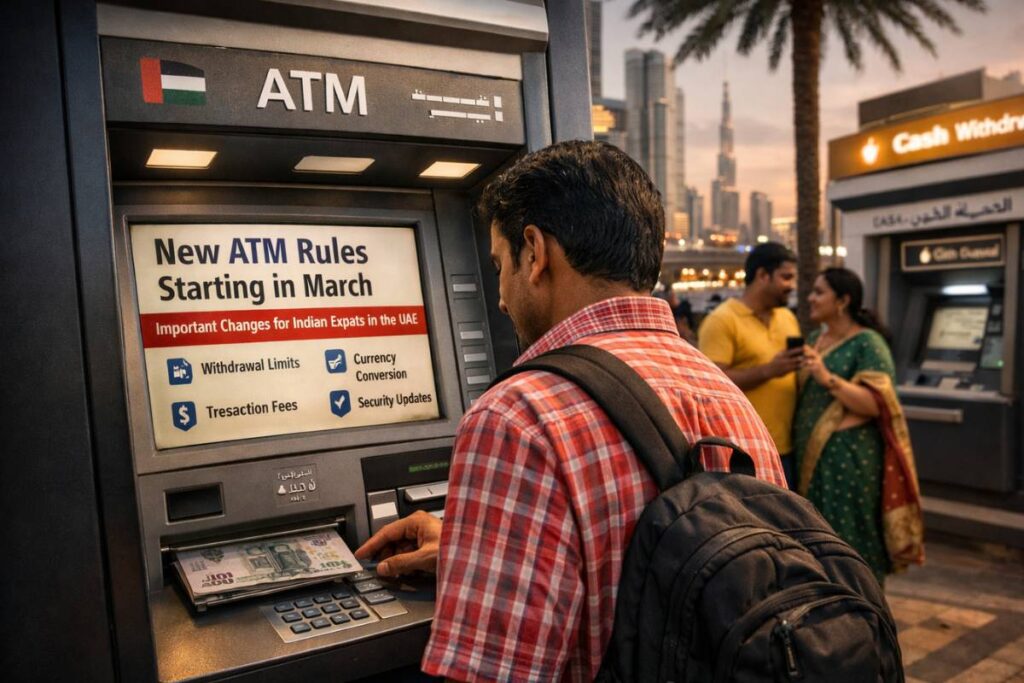
Executive Summary: Revised Automated Teller Machine (ATM) operational standards and cross-border interchange directives established by the Central Bank of the UAE (CBUAE) alter the financial mechanics of cash withdrawals for over 3.5 million Indian expatriates residing across the Emirates. While domestic interbank ATM cash withdrawal fees for local UAE bank debit cards remain strictly regulated under CBUAE consumer protection caps (capped at AED 2 per interbank withdrawal), cross-border withdrawals using debit cards issued by Indian banks—including State Bank of India, HDFC Bank, and ICICI Bank—face stricter Dynamic Currency Conversion (DCC) fee disclosures, network interchange adjustments, and mandatory optical screening. Compounded by India’s cross-border remittance taxation rules enforced by the Reserve Bank of India (RBI), Indian expats utilizing non-resident or domestic rupee cards face significant transactional fee leakages if withdrawals are not strategically routed.
CBUAE Fee Architecture: Domestic Switch vs. International Cards
Under CBUAE Consumer Protection Regulations, retail banking institutions operating across Dubai, Abu Dhabi, and the Northern Emirates must maintain strict fee ceilings on local retail payments. When an expat uses a UAE-issued debit card (such as Emirates NBD, First Abu Dhabi Bank, or Mashreq) at another local bank’s ATM, the UAE Switch interbank clearing fee is legally restricted to AED 2 (plus 5% VAT) per cash withdrawal, with balance inquiries capped at AED 1.
However, these statutory caps do not shield cardholders utilizing debit cards issued outside the UAE. When an Indian expatriate inserts an Indian-issued international debit card into an Emirates ATM, the transaction operates outside the domestic UAE Switch framework, routing instead through Visa, Mastercard, or RuPay International clearing corridors. This transition exposes the transaction to three separate fee layers:
- ATM Acquirer Convenience Fee: Fixed terminal access fees levied by local UAE acquiring banks, ranging between AED 15 and AED 25 per transaction.
- Issuing Bank International Cash Withdrawal Surcharge: Fixed fees charged by the Indian issuing bank (typically ₹125 to ₹250 per withdrawal).
- Foreign Exchange Markup Fee: Currency conversion spreads averaging between 2.0% and 3.5% above benchmark interbank rates.
This fee tiering forms part of broader financial infrastructure modernization across the Emirates, matching regulatory compliance overhauls analyzed in our coverage of UAE sweeping fintech regulations and compliance standards.
The Dynamic Currency Conversion (DCC) Transparency Mandate
The core operational shift involves mandatory screen disclosures for Dynamic Currency Conversion (DCC). Historically, when Indian cardholders withdrew United Arab Emirates Dirhams (AED), ATM interfaces prompted users to “bill in home currency” (Indian Rupee, INR). Many expats accepted this prompt under the mistaken belief that home-currency billing avoided currency conversion charges.
In reality, accepting DCC allows the terminal operator’s merchant bank to apply proprietary commercial exchange rates, embedding markups of 5% to 8% above the mid-market rate on top of local handling fees. Under the updated CBUAE guidelines, ATM operators must prominently display the exact exchange rate markup and total transaction cost in both AED and the card’s billing currency before dispensing cash, allowing consumers to reject DCC and choose local currency settlement.
Comparative Cost Breakdown: Withdrawing AED 1,000 at a UAE ATM
The table below models the total effective transaction cost of withdrawing AED 1,000 (approx. ₹22,700) across different card types and settlement methods:
| Card Type & Processing Channel | Terminal / Switch Fee | Foreign Bank Fee | FX Markup / DCC Margin | Total Overhead Cost (AED) |
|---|---|---|---|---|
| Domestic UAE Bank Debit Card (Interbank ATM) | AED 2.10 (CBUAE Capped) | Zero | 0.0% (Domestic Currency) | AED 2.10 (~0.2%) |
| Indian NRE Debit Card (Local Settlement) | AED 15 – 20 | ₹150 (~AED 6.6) | 1.5% – 2.0% (Visa/Mastercard) | AED 38 – 47 (~4.2%) |
| Indian Domestic Rupee Card (Local Settlement) | AED 15 – 20 | ₹200 (~AED 8.8) | 3.0% – 3.5% FX Spread | AED 55 – 65 (~6.0%) |
| Indian Card with DCC Accepted (Home Currency Prompt) | AED 15 – 20 | ₹200 (~AED 8.8) | 6.0% – 8.0% DCC Spread | AED 85 – 110 (~9.5%) |
Dual Compliance: India’s LRS and Tax Collected at Source (TCS)
For Indian expats and resident Indians visiting the UAE, cash withdrawals made using domestic Indian debit cards are legally governed by the Income Tax Department of India and RBI Liberalised Remittance Scheme (LRS) regulations. Under current provisions, international debit card debits count toward the individual’s annual $250,000 LRS limit.
Furthermore, cross-border remittances and overseas card expenditures exceeding ₹7 lakh in a financial year trigger Tax Collected at Source (TCS) at rates up to 20% (for non-medical and non-educational expenses). While legitimate non-resident Indians maintaining Non-Resident External (NRE) accounts are exempt from domestic Indian TCS on overseas card usage, expats using resident Indian bank accounts face automatic tax deductions at the time of debit.
These international cross-border payment frictions highlight the growing consumer migration toward digital alternative remittance channels and stablecoin protocols, as explored in our regulatory analysis of how the UAE is rewriting regulatory frameworks for stablecoins and digital payments.
Strategic Best Practices for Indian Expats
To eliminate unnecessary transaction leakage, financial advisers recommend adhering to three foundational banking rules:
- Always Decline DCC at the Terminal Screen: When an ATM asks whether you wish to be billed in Indian Rupees or UAE Dirhams, always select “Without Conversion” or “Bill in AED.” This forces the transaction through standard wholesale network rates rather than the ATM operator’s inflated conversion matrix.
- Transition to Domestic UAE Salary Accounts: Use domestic Wage Protection System (WPS) accounts for cash handling. Interbank withdrawals remain legally capped at AED 2 across all UAE ATMs.
- Utilize NRE Rather Than Resident Domestic Cards: If emergency access to Indian funds is necessary, deploy a Non-Resident External (NRE) debit card. NRE accounts draw from tax-exempt foreign earnings and are fully insulated from India’s 20% LRS TCS tax withholding rules.
These retail banking adjustments mirror broader structural policy revisions across retail banking portfolios, including premium banking access thresholds documented in our report on major Indian banks updating airport lounge and debit card privileges.
Frequently Asked Questions
What is the statutory fee for using another bank’s ATM in the UAE?
Under Central Bank of the UAE regulations, interbank cash withdrawals using local UAE debit cards are capped at AED 2.00 (plus 5% VAT, total AED 2.10) per transaction, while balance inquiries are capped at AED 1.05.
Why is withdrawing cash with an Indian debit card in the UAE expensive?
Indian-issued cards do not qualify for domestic fee caps. Transactions incur local ATM access fees (AED 15–20), Indian bank international withdrawal fees (₹150–250), and a 2.0%–3.5% foreign exchange markup, amounting to total overheads of 4% to 6% per withdrawal.
Should I choose ‘With Conversion’ or ‘Without Conversion’ at UAE ATMs?
Always choose “Without Conversion” (Bill in AED). Choosing “With Conversion” activates Dynamic Currency Conversion (DCC), allowing the terminal owner to apply an inflated conversion rate with built-in profit margins of 5% to 8%.
Does India’s 20% TCS apply to NRE debit card ATM withdrawals in the UAE?
No. Non-Resident External (NRE) accounts represent foreign earnings and are exempt from the Reserve Bank of India’s Liberalised Remittance Scheme (LRS) and Tax Collected at Source (TCS). TCS only applies if you use a resident Indian domestic bank account abroad exceeding ₹7 lakh in a financial year.